How Messenger's "Delete Conversation" Feature Actually Works Under the Hood
On this page
Many everyday developers assume that clicking the "Delete Conversation" button in a chat app fires a direct DELETE query to the database. If you are building a small weekend project, this brute-force approach might work just fine. But when you are dealing with high-throughput distributed systems like Messenger that process millions of requests per second, running hard deletes or duplicating data for every single user can turn into an engineering disaster. Let us start by looking at why simple approaches completely fail in a production environment.
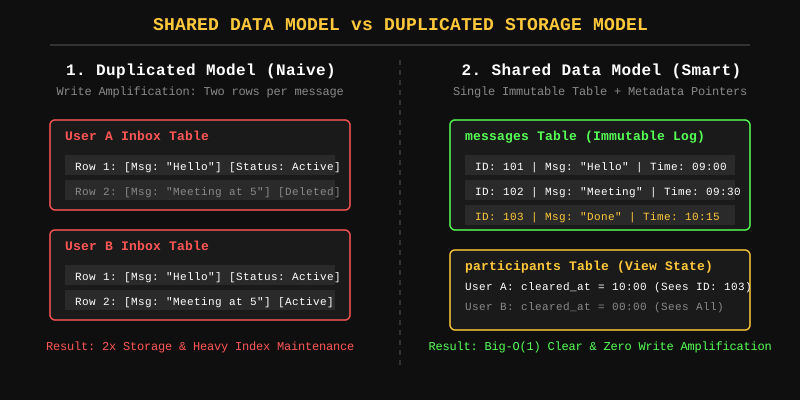
- Hard Delete Fallacy: When you delete a chat and the system runs a direct delete query, your request wipes the entire conversation from both your inbox and the inbox of the person you were chatting with. This is unacceptable because it destroys both business record recall and the overall user experience.
- Data Duplication Anti-Pattern: To get around this, many developers think about creating separate database rows for each user. But the moment you write two database rows for every single message, you trigger massive write amplification across your system.
- Impact on Production: Duplicating data causes storage costs to skyrocket. On top of that, your database indexes become extremely heavy, query latency grows exponentially, and the entire system slows to a crawl.
- The Core Solution: To solve this complex problem, scalable systems like Messenger rely on smart metadata management and timestamp-based view filtering. This approach lets the backend clear an entire conversation at Big-O(1) storage complexity without actually deleting any underlying messages.
Foundational Mental Model and a Real-World Analogy
Before we get into the low-level architecture, we need to clear up one core concept: Shared Immutable Data versus User-Specific View State. The main philosophy here is that your primary data or message log always stays untouched. Instead of altering the real records, we simply shift the boundaries of the user's read queries. We can use a familiar real-world analogy to make this engineering concept easy to visualize and understand.
- The Setup: Imagine a massive shared noticeboard on your office wall where everyone posts daily company announcements.
- The Problem: The old notices from several months ago are cluttering your view and distracting you, but your coworker still desperately needs those exact older documents for their current project.
- The Naive Fixes: If you rip those old notices off the board (a Hard Delete), your coworker gets stranded without their data. On the flip side, building two massive, separate noticeboards for the two of you (Data Duplication) is an expensive and unrealistic waste of space.
- The Smart Solution: A much smarter fix is to put on a special pair of glasses or a tinted visor with built-in filter logic that says, "Do not show me any notices posted before 10:00 AM today." The old notices remain safely tacked to the physical board, but your eyes only register the items posted after ten in the morning.
- Application to Software: In our software architecture, the database is that shared office noticeboard. The timestamp stored inside the user's profile metadata acts as the digital filter in your glasses.
Under-the-Hood Architecture (The Core Deep Dive)
Now let us step directly inside the database engine to see how this works in practice. To make this architecture function efficiently at scale, we split our relational or NoSQL document store into two distinct operational layers. This separation of concerns allows us to write messages fast while reading them with custom boundaries.
A. messages Table (The Immutable Log)
This is our primary message storage, and it operates entirely as an append-only table. During normal application workflows, we never run UPDATE or DELETE queries against this table. Avoiding modifications keeps our write paths fast and prevents locking issues across distributed nodes. The core columns in this table are message_id (UUID), conversation_id (Indexed UUID), sender_id (UUID), payload (Text/Blob), and created_at (Timestamp).
B. conversation_participants Table (The View State Engine)
This table is the real engine behind our custom view states. It tracks personal status and visual boundaries for every individual user in every chat thread. Its core columns include conversation_id, user_id, last_read_timestamp, and, most importantly, cleared_at_timestamp. That final timestamp acts as an invisible wall that blocks older messages from appearing in the user interface.
The Query Mechanics
When a user loads their inbox or opens a specific chat thread, our backend engine never runs a basic SELECT * query. Instead, the system executes a filtered read query that dynamically checks the user's metadata boundary. The SQL logic for this read operation looks like the following snippet:
SELECT message_id, sender_id, payload, created_atFROM messagesWHERE conversation_id = 'conv_12345' AND created_at > ( SELECT cleared_at_timestamp FROM conversation_participants WHERE conversation_id = 'conv_12345' AND user_id = 'user_A' )ORDER BY created_at ASC;Index Optimization (B-Tree / LSM-Tree)
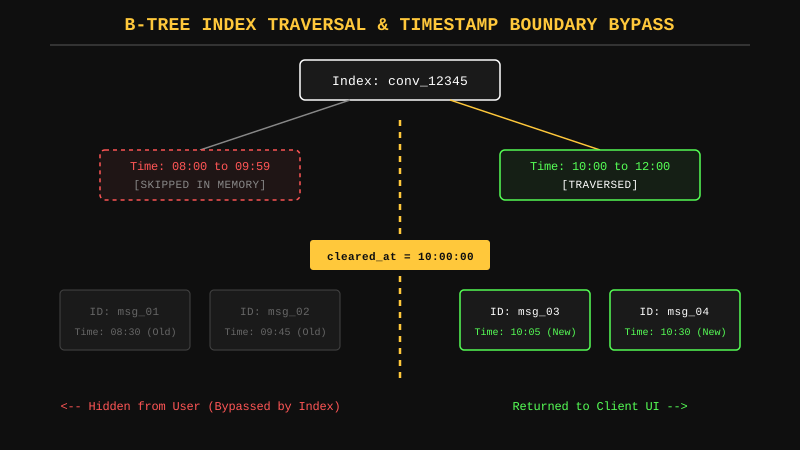
To run this query across millions of messages without slowing down, we must avoid a full table scan at all costs. We solve this by building a composite index on (conversation_id, created_at). When the read query hits the database, the engine uses this B-Tree or LSM-Tree index to traverse the tree with Big-O(log N) time complexity. Because of how the index is ordered, any messages older than the cleared_at_timestamp get skipped right at the memory level. This structure makes query execution lightning fast, even when a conversation contains years of history.
Step-by-Step Execution Trace and Code Mechanics
Let us walk through a step-by-step execution trace to see what happens under the hood when you press that "Delete Conversation" button in your application interface. Understanding this flow helps clarify how the frontend, backend, and database interact without deleting physical rows.
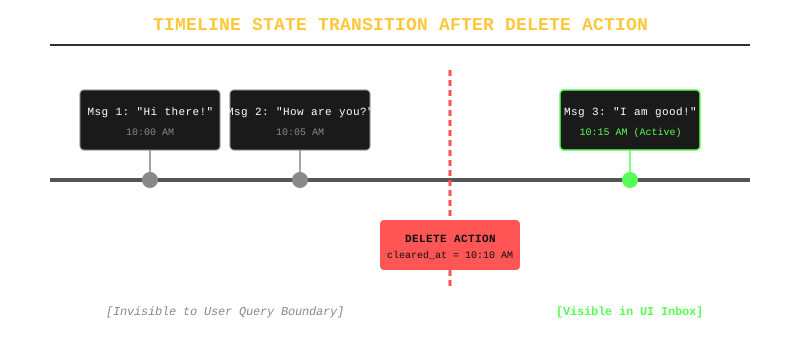
- Step 1: User Triggers "Delete Conversation": The client application sends a request to the backend endpoint at
POST /api/v1/conversations/{id}/clear. Once the backend receives this call, it completely ignores themessagestable. The system simply updates thecleared_at_timestampcolumn for that specific user in theconversation_participantstable, setting it to the current timestamp. At the same time, it evicts the old metadata from Redis or the application cache to keep read performance sharp. - Step 2: The Inbox List Re-render: The moment the timestamp updates, the app runs its filtered query to render the inbox. Since no messages exist with a creation time greater than the new
cleared_at_timestamp, the query returns a count of zero. The application UI responds by hiding the chat window or rendering a clean, blank slate. - Step 3: New Message Arrival: A few minutes later, the other user sends you a fresh message. This new payload gets appended to the
messagestable just like normal. A message broker like Kafka or RabbitMQ then routes a push notification directly to your device. - Step 4: The Re-emergence in Inbox: When you open the application again, the backend executes the same filtered query. Because the
created_attimestamp of this new message is greater than yourcleared_at_timestampboundary, the database returns the new item. The UI instantly reactivates the chat box to display only the new message, leaving all older chat history trapped behind that invisible wall.
Important
Soft Delete vs. Timestamp Boundary
Setting an individual is_deleted flag on every single message (Soft Delete) is a slow and expensive operation because the database must update every historical row. In contrast, updating a single cleared_at_timestamp metadata value guarantees Big-O(1) time complexity and brings system write amplification down to zero.
Edge Cases, Pitfalls, and Architectural Trade-offs
When you design a scalable architecture, you cannot rely solely on the happy path. High production loads and strict memory constraints force us to account for several critical edge cases and system trade-offs. Let us examine the most common traps developers encounter and how to engineer around them.
A. Storage Growth vs. Garbage Collection (GDPR Compliance)
Problem: If we never delete underlying messages and store logs forever, our storage costs will eventually shoot through the roof. On top of that, international privacy laws like Europe's GDPR make it illegal to store deleted user data forever.
Solution: We handle this by running background asynchronous garbage collection or scheduled cron jobs. The background job regularly checks the database. When the cleared_at timestamps for both participants in a conversation are greater than the created_at timestamp of a specific message, it means neither user wants to see it anymore. Only then does the system execute a hard delete to wipe those old messages from the disk.
Warning
The Compliance & Privacy Trap
If your system lacks an automated data retention policy and a dual-deletion purge mechanism, relying purely on timestamp-based filtering will expose you to severe legal risks. Building background garbage collection is mandatory for protecting user privacy and staying compliant.
B. Index Bloating and Performance Degradation
Problem: When millions of deleted messages accumulate in your tables, the database engine has to bypass a massive number of dead or invisible nodes every time it traverses an index. Over time, this overhead causes read latency to creep upward and degrades overall system responsiveness.
Solution: We stop this performance drop by using database partitioning and time-series bucketing. We regularly move aging data out of the active index and shift it into cold storage. This practice keeps the hot, active index compact and lightning fast.
C. Clock Skew in Distributed Servers
Problem: In a global distributed system, servers spread across different regions can experience slight timing differences known as clock skew. Even a few milliseconds of drift can cause timestamp mismatches and trigger race conditions where brand-new messages accidentally get trapped behind the invisible wall.
Solution: You should never rely on local server time to prevent these timing discrepancies. Instead, use database-generated UTC timestamps or centralized, monotonically increasing time sources like Google TrueTime or Snowflake IDs.
Tip
Query Optimization Pro-Tip
Always follow the Leftmost Prefix Rule when building composite indexes in your database. Because of our specific query pattern, your (conversation_id, created_at) index must place conversation_id first and created_at second. This structure lets the database isolate the correct chat thread first before it filters out the timestamp boundaries.
Summary and Production Decision Rules
The core takeaway from our deep dive is simple: when building scalable systems, always replace brute-force database operations with smart metadata and query boundaries. As you design the architecture for your next project, use this production decision matrix as a practical reference guide to choose the right approach for your specific requirements.
| Architectural Model | When to Use | Key Advantages and Trade-offs |
|---|---|---|
| Duplicated Data Model | Small-scale applications or systems that require strict, isolated end-to-end encryption. | Gives each user total control over their data, but write amplification and storage costs are extremely high. |
| Row-Level Soft Delete | When users need to delete specific, individual messages (such as "Unsend" or "Delete for everyone" features). | Makes it easy to target single items, but clearing entire chat histories puts heavy operational pressure on the database. |
| Timestamp-Based View Filtering | When users want to clear entire chat threads or inbox feeds with a single click. | Delivers zero write amplification and Big-O(1) complexity. However, it requires you to manage background garbage collection and strict timestamp synchronization. |
Hopefully, the next time you design a database or chat system for a high-throughput application, this timestamp-based filtering logic will help you build a cleaner, faster, and more reliable backend. Happy coding!