How the Transactional Outbox Pattern and Idempotency Really Work Under the Hood in Distributed Systems
On this page
When we transition from a monolithic architecture to microservices, the biggest and most intimidating challenge we face is handling distributed transactions and data consistency. In a monolithic application, we have a single relational database where we can easily use ACID transactions to guarantee atomicity. But once we move to a microservices architecture, every service has its own dedicated database and relies on the network or a message broker to communicate with other services. This creates a complex architectural puzzle that can silently corrupt your production database if you do not solve it with the right system design.
Today, we will talk directly about why standard retry mechanisms or try-catch blocks fail in large-scale distributed systems. We will explore how you can use the Transactional Outbox Pattern along with idempotent consumer mechanisms to design a production-grade, fault-tolerant system. Let us analyze this topic from the ground up, right down to the low-level engine mechanics.
1. The Core Mystery and Why It Matters
When a service updates its local database and immediately publishes an event to an external message broker like Apache Kafka or RabbitMQ, we call that pattern a dual-write. On the surface, this looks like a very straightforward and simple piece of logic, but from a system architecture perspective, it is a dangerous anti-pattern. When you try to execute write operations across two completely different and independent storage engines inside the same code block, network latency and partial failures will quickly push your system into an inconsistent state.
Imagine you are building the order service for an e-commerce platform. When a user places an order, your code first saves the order details in the database and then sends an OrderCreated event to the Kafka broker so the inventory service can reduce stock and the payment service can process the charge. Now think about what happens if your database transaction succeeds and the data is saved in the orders table, but right at that exact millisecond, the Kafka broker goes down or your network connection drops. As a result, the event is never published to Kafka. Your order service assumes the order was successful, but the inventory and payment services know nothing about it. This exact condition is called silent data corruption, and it completely destroys your core business logic.
Many experienced engineers try to solve this problem by relying on standard try-catch blocks or retry loops. They assume that if sending the event to Kafka fails, the code can simply retry a few times or throw an exception to roll back the database transaction. In a distributed system, this assumption is completely flawed. If your message reaches the Kafka broker successfully, but a network partition occurs while the acknowledgment is traveling back to your application, your application will think the message never arrived. If you trigger a retry, you will send the exact same message to Kafka twice. If you decide to roll back the database transaction instead, the message remains in Kafka while the database record disappears. The only way out of this logical trap is to leverage the atomic power of your database.
2. The Foundational Mental Model and Analogy
The foundational concept behind the Transactional Outbox Pattern is brilliant and straightforward. We completely stop trying to send data to an external message broker in real time. Instead, we rely on the atomic ACID properties of our local database. When a business transaction occurs, we save the event payload inside a special table within the exact same database transaction as our primary business data. This special table is called the outbox_messages table. Because both tables reside within the same database and share a single transaction, the database engine guarantees that either both writes succeed simultaneously or neither of them does.
To make this concept crystal clear, we can look at a real-world banking analogy. Imagine you are standing at a bank counter, and you want to transfer money to an account at a different bank. If the bank teller tries to connect directly to the other bank's servers in real time while you stand there, any network slowdown will freeze or ruin your transaction. Instead, the teller does something much smarter: they record the withdrawal in their local ledger to deduct money from your account, and in that exact same ledger, they write an entry in an outbox section noting that a check must be mailed to the other bank. The teller completes this entire task with a single stroke of a pen. Later, background staff collect those notes from the outbox section and safely mail the checks when the timing is right.
In distributed systems engineering, we call this mental model Eventual Consistency. We let go of the unrealistic expectation of strict real-time synchronization and design the system so that all data across different services synchronizes within a few milliseconds or seconds. Using real-time distributed locking in high-throughput architectures is impossible, which makes Eventual Consistency the only practical solution for production systems.
3. Under-The-Hood Architecture (The Core Deep Dive)
Now let us examine how this entire process works under the hood at the memory and disk level of the engine. When you start a transaction in a relational database like PostgreSQL or MySQL, the database engine does not touch your main data files directly. Instead, it records your change instructions in an optimized, sequential disk file called the Write-Ahead Log, or WAL. When you insert data into both the orders table and the outbox_messages table within the same transaction, the database engine writes those two operations into memory buffers as part of a single WAL entry and later flushes them to disk.
When you issue the COMMIT command, the database engine ensures that the changes for both tables are written atomically to the WAL file. If the server crashes or loses power right during the disk write, the database engine will read the WAL file during restart and roll back the entire incomplete transaction. This guarantees 100% synchronization between your business data and your outbox events. There is zero external network risk here because the entire workflow happens inside the internal storage engine of your database.
While the outbox pattern gives us strict consistency at the database level, we must pay careful attention to message delivery guarantees when transferring data from the message broker to consumer services. Distributed systems generally offer three types of delivery guarantees: at-most-once, at-least-once, and exactly-once. The outbox pattern provides an at-least-once delivery guarantee by default. This means your event will reach the consumer service at least one time, but network retries or failure recoveries might cause the exact same event to arrive multiple times.
Many developers assume that modern brokers like Kafka provide end-to-end exactly-once delivery, but in the low-level reality of distributed systems, true end-to-end exactly-once delivery is practically impossible. A broker might prevent duplicates within its own internal layers, but network latency can easily cause your background poller or consumer service to process the same message twice. Therefore, in reliable production architectures, we always pair at-least-once delivery guarantees with idempotency logic on the consumer side to achieve exactly-once processing.
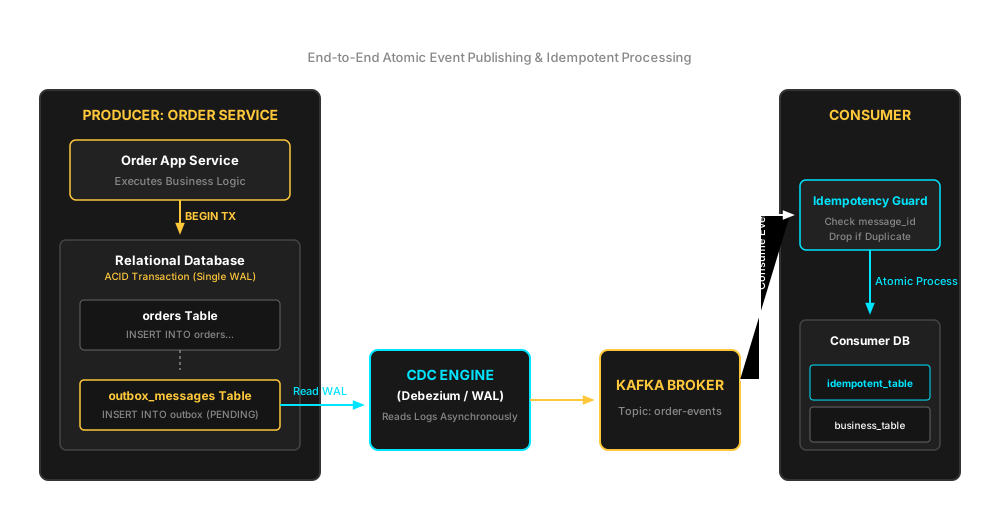
In the architectural diagram shown above, you can see how our primary application updates both the business table and the outbox table inside a single database transaction. Afterwards, a background process or a Change Data Capture engine reads the data from that outbox table and pushes it to the message broker. Finally, the consumer service receives the event and executes an idempotency check before processing the business logic.
4. Step-by-Step Execution Trace and Code Mechanics
To design a production-ready architecture, we first need to understand the database schema and backend code mechanics. Let us walk through the execution trace step by step.
Step 1: The Blueprint for SQL Schema Design
We need a specific database schema to store our outbox messages reliably. This table must track the event payload, processing status, and retry attempts. At the same time, we need to create an idempotency table in the consumer service database to prevent duplicate message processing.
-- Outbox table in the producer service databaseCREATE TABLE outbox_messages (    id UUID PRIMARY KEY DEFAULT gen_random_uuid(),    aggregate_type VARCHAR(255) NOT NULL, -- For example: 'ORDER'    aggregate_id VARCHAR(255) NOT NULL,   -- For example: Order ID    event_type VARCHAR(255) NOT NULL,     -- For example: 'ORDER_CREATED'    payload JSONB NOT NULL,               -- Complete event payload    status VARCHAR(50) DEFAULT 'PENDING', -- PENDING, PROCESSED, or FAILED    retry_count INT DEFAULT 0,    created_at TIMESTAMP WITH TIME ZONE DEFAULT CURRENT_TIMESTAMP,    processed_at TIMESTAMP WITH TIME ZONE);
-- Idempotency table in the consumer service databaseCREATE TABLE idempotent_consumers (    message_id UUID PRIMARY KEY,          -- Outbox table ID serves as the unique key here    processed_at TIMESTAMP WITH TIME ZONE DEFAULT CURRENT_TIMESTAMP,    status VARCHAR(50) NOT NULL           -- SUCCESS or FAILED);
Step 2: Atomic Transaction Implementation Code
Now let us use Node.js and the Prisma ORM to see how we create an order and insert an outbox record inside a single atomic transaction block. Notice that we make zero external Kafka or network calls inside this block.
import { PrismaClient } from '@prisma/client';import { randomUUID } from 'crypto';
const prisma = new PrismaClient();
async function createOrderWithOutbox(userId: string, totalAmount: number, items: any[]) {  const orderId = randomUUID();  const eventId = randomUUID();
  // Starting a single atomic transaction  try {    const result = await prisma.$transaction(async (tx) => {      // 1. Save the order in the main business table      const newOrder = await tx.orders.create({        data: {          id: orderId,          userId: userId,          totalAmount: totalAmount,          status: 'CREATED',        },      });
      // 2. Save the event payload in the outbox table      await tx.outbox_messages.create({        data: {          id: eventId,          aggregate_type: 'ORDER',          aggregate_id: orderId,          event_type: 'ORDER_CREATED',          payload: JSON.stringify({            orderId: newOrder.id,            userId: newOrder.userId,            amount: newOrder.totalAmount,            items: items,          }),          status: 'PENDING',        },      });
      return newOrder;    });
    console.log(`Order and Outbox entry created atomically with ID: ${result.id}`);    return result;  } catch (error) {    // If any database error occurs, both table write operations roll back together    console.error('Failed to execute atomic transaction, rollback completed.', error);    throw error;  }}
Warning
External Network Calls Inside DB Transactions: Never place external message broker publishing code (such as await kafka.send()) inside your local database transaction blocks. If the external network call experiences latency or times out, it will keep your database connection pool locked for an extended period. Other users will be blocked from getting database connections, causing cascading failures that take your entire application down.
Step 3: The Outbox Publisher (Poller vs CDC)
Our database is now storing events in a PENDING state. We need a background worker to pick up these records and send them to our message broker. Engineers generally use two distinct mechanisms for this task: custom polling or Change Data Capture (CDC).
In a custom polling mechanism, your application runs a scheduled cron job or background thread that executes a query like SELECT * FROM outbox_messages WHERE status = 'PENDING' ORDER BY created_at ASC LIMIT 100 every few milliseconds. The worker reads those messages, sends them to Kafka, and then updates the database records to a PROCESSED state. This works fine for small or medium-scale applications, but in high-throughput systems, it generates intense read-write pressure on your database.
The modern production solution for this bottleneck is using a Change Data Capture tool, with Debezium being the industry favorite. Debezium never executes standard SQL queries against your database. Instead, it reads your database engine's Write-Ahead Log or binary log files directly as a continuous, low-level byte stream. Whenever a new row is inserted into the outbox_messages table, Debezium captures the event from the log file and pushes it to Kafka within milliseconds without generating any database table locks.
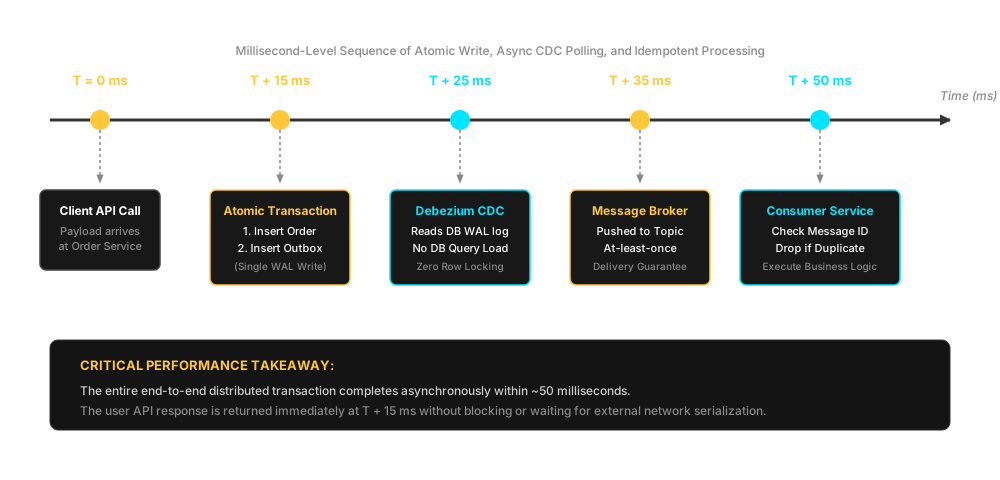
In the timeline diagram above, you can trace the exact millisecond-level flow from the initial client HTTP request to the database commit, the CDC log reading, the Kafka broker publishing, and finally the idempotent processing in the consumer service.
5. Distributed Failure Modes (What Breaks & How to Fix)
The true measure of any software architecture is how it behaves when hardware and networks fail. Let us analyze three realistic failure scenarios in distributed systems and examine their structural solutions.
Scenario 1: The Message Broker Goes Completely Down
-
The Architectural Disaster: Your outbox publisher or CDC engine tries to send messages to Kafka, but the broker has crashed and refuses connections. A massive backlog of thousands of
PENDINGmessages builds up inside your outbox table, while your background workers continuously retry and exhaust your database connection pool. -
The Structural Solution: You must implement an exponential backoff with jitter mechanism. Instead of retrying immediately, the background worker should increase its waiting period after every failed attempt, scaling from 2 seconds to 4, 8, and 16 seconds. You must also add randomized timing, known as jitter, so all your background workers do not hit the database or broker at the exact same millisecond and trigger a thundering herd problem.
Scenario 2: Dual Message Delivery
-
The Architectural Disaster: Your outbox publisher successfully sends an event to Kafka, and Kafka delivers it to the consumer service. The consumer service processes a user payment completely, but right as it sends an acknowledgment back to Kafka, the network connection drops. Kafka assumes the message was never processed, so its internal retry logic sends the exact same message to the consumer again. This results in a catastrophic failure where the user gets charged twice for the exact same order.
-
The Structural Solution: You solve this by building an idempotent consumer layer inside your target service. When a message arrives, the service does not execute its business logic immediately. Instead, it extracts the unique
message_idand checks its own database inside theidempotent_consumerstable. If that ID already exists, the service skips the operation entirely and sends a success acknowledgment back to Kafka. If the ID is missing, the service executes the business logic and inserts the ID into theidempotent_consumerstable within the same database transaction.
Tip
High-Throughput Distributed Locking: When your consumer service receives hundreds of thousands of requests per second, performing constant read-write checks against a relational database for idempotency can degrade performance. In these extreme high-throughput scenarios, you can use a Redis distributed lock (such as the Redlock algorithm) to complete idempotency checks directly in memory. However, always keep a unique key constraint on your relational database as your final safety net.
Scenario 3: Out-of-Order Event Processing
-
The Architectural Disaster: Network latency or Kafka partition rebalancing causes messages to arrive out of their original sequence. Imagine an
Order_UpdatedorOrder_Cancelledevent arriving at your consumer service before the initialOrder_Createdevent gets there. If the consumer tries to process an update on an order that does not exist in its local database yet, the entire operation crashes. -
The Structural Solution: You must include an incremental version number or a precise timestamp inside your event payload. Your consumer service must implement state machine logic to check if the incoming event's version is greater than the current database record's version. If an event arrives out of order, the consumer places it into a temporary buffer or a Dead Letter Queue (DLQ) and reprocesses it after the missing sequence events arrive.
6. High-Throughput Performance Tuning
When your system scales up to handle 10,000 or more events per second, standard basic implementations quickly turn into performance bottlenecks. You must apply specific low-level optimization strategies to keep your system running smoothly under heavy loads.
First, we need to understand the technical justification for choosing Change Data Capture over custom polling in production. When you run SELECT * FROM outbox_messages WHERE status = 'PENDING' hundreds of times a second, you force the database engine to perform repeated table scans. Furthermore, when your worker updates thousands of records after publishing (UPDATE outbox_messages SET status = 'PROCESSED'), it triggers row-level locks across the table. This constant read-write friction slows down your primary business transactions. Debezium avoids this entirely by reading the WAL file externally, adding zero read load or locking overhead to your database tables.
Second, if you decide to use a polling mechanism for smaller deployments, you must build an optimized indexing strategy. Creating an index on just the status column is useless because almost every record in the table eventually turns into PROCESSED, which creates low cardinality. Instead, you must create a composite B-Tree index on the (status, created_at) columns. This allows your database engine to locate the oldest pending messages instantly with time complexity without ever scanning the entire table.
Third, you should use batching and pipelining when transferring data to your message broker instead of sending single network calls. Wasting TCP handshakes and network round-trip times (RTT) to publish messages one by one is highly inefficient. Instead, your worker should read 500 or 1,000 messages into a memory buffer and use the broker's batch producer API to send the entire payload over a single network request. This massively multiplies your network throughput and drops end-to-end system latency.
Important
Outbox Table Cleanup and Purge Policy: Never treat your outbox table as permanent storage. Once messages are successfully published to your broker, your table will rapidly accumulate millions of PROCESSED rows. This bloats your database size and degrades index performance. You must run a scheduled cron job or a dedicated purge policy (such as running daily at 3:00 AM) to archive or delete old processed records.
7. Alternative Solutions and Trade-off Matrix
A core responsibility of a senior architect is evaluating trade-offs instead of blindly implementing patterns. Beyond the outbox pattern, the software industry uses several other techniques to handle data consistency across distributed systems. Let us look at a direct comparison.
The Two-Phase Commit (2PC) protocol is a classic distributed transaction mechanism where a central coordinator tells all participating databases and brokers to prepare for a commit (the Prepare Phase), and only commands them to commit once every participant agrees (the Commit Phase). While this guarantees strong consistency, its biggest drawback is that it is a blocking protocol. If a single node experiences slowdowns, every transaction across the entire system locks up and waits, making it completely unsuitable for modern high-scale microservices.
You can easily evaluate the trade-offs of these architectural approaches using the comparison matrix below:
| Architectural Approach | Data Consistency | System Complexity | Performance and Latency |
|---|---|---|---|
| Dual Write (Anti-Pattern) | Very Low (Partial failure prone) | Low | Low Latency (High Risk) |
| Two-Phase Commit (2PC) | High (Strict synchronous) | Very High | High Latency (Blocking) |
| Transactional Outbox | Guaranteed Eventual Consistency | Medium | Low Latency (Asynchronous) |
This matrix shows clearly that when we want the best balance between system complexity and operational latency, the Transactional Outbox Pattern provides the most reliable, production-ready solution.
8. Summary and Production Decision Rules
We have explored the engineering principles behind reliable distributed data, and now it is time to apply them to your daily system design decisions. Keep in mind that you do not need to use this pattern everywhere. Follow these production decision rules to guide your architectural choices:
-
When to use the Outbox Pattern: Use this pattern whenever you are handling critical business transactions where losing data or having inconsistent states is unacceptable. If you are building systems for financial transactions, payment processing, order placement, or inventory management, implementing a Transactional Outbox and idempotent consumers is mandatory.
-
When simple event publishing is enough: If you are only publishing events for analytics tracking, general user activity logging, or non-critical background notifications where dropping or duplicating a few messages will not hurt the business, you can publish directly to the broker. There is no need to add the engineering complexity of an outbox table for non-critical data.
-
The Architect Mindset Shift: Junior and mid-level developers often write code assuming their networks and servers will work perfectly 100% of the time. A senior architect writes code assuming by default that networks will partition, databases will experience slowdowns, and brokers will deliver duplicate messages. Shifting your mindset toward expecting failure is what moves you from building basic applications to designing resilient, fault-tolerant distributed systems.
When you understand these low-level mechanics and implement them cleanly in your production architecture, your systems will handle massive traffic spikes and unexpected infrastructure failures with complete reliability.