Google Did the Research, OpenAI Captured the Value: An Under-the-Hood Look at Generative AI Architecture
On this page
There is a common misconception among everyday technology users and even many junior software engineers that today's generative AI and large language model revolution belongs entirely to OpenAI. When we interact with powerful models like ChatGPT, Claude, or Gemini, it feels as though this entire technology was born inside OpenAI's private laboratories. But if you look under the hood at the actual engineering architecture, you will find a very different story. The true backbone of this entire revolution lies within a historic 2017 research paper published by Google.
In this engineering deep dive, we will analyze how a breakthrough architecture invented by Google completely changed the technology landscape. We will examine why Google failed to capture the first-mover advantage itself, and how OpenAI used that open-source technology to pull off one of the biggest value captures in tech history. At the end of this article, you will find reference links to all the original research papers and technical documentation so you can explore the math and mechanics yourself.
The Historic Turning Point in Tech
In mid-2017, a team of eight scientists from Google Brain and Google Research published a paper titled Attention Is All You Need. While the paper created a huge buzz in academic circles at the time, very few people in the broader software industry realized the massive earthquake it was about to trigger.
This research paper introduced the world to the Transformer architecture for the very first time. If you use ChatGPT today, that final letter "T" actually stands for Transformer, as in Generative Pre-trained Transformer. This means the core engine powering your complex code debugging and natural language conversations was built entirely inside Google's labs. Instead of locking away this breakthrough invention for internal use only, Google decided to open-source it for the global developer community. That exact decision kicked off one of the most significant strategic shifts in software history.
A Foundational Mental Model and Analogy
Before we get into the technical architecture, let us break down the entire situation using a real-world analogy. Imagine a world-famous, top-tier restaurant chain (Google) that spends years in its R&D kitchen developing an extraordinary new recipe for biryani (the Transformer architecture). This recipe is so advanced that it allows chefs to prepare delicious food for millions of people at a fraction of the usual cost and cooking time.
However, the restaurant chain hesitates to put this new dish on its official menu. The executives worry that launching something so new and disruptive might hurt the quality and sales of their existing, highly profitable menu items. Instead of commercializing the recipe, they publish it in an open cookbook for anyone in the culinary world to read and use.
Right around that time, a small but ambitious catering startup (OpenAI) gets hold of the public cookbook. They realize that while the recipe itself is brilliant, the real magic happens when you scale it up using a massive industrial kitchen (supercomputing power) and tons of raw ingredients (big data). The startup quickly builds the necessary infrastructure, cooks up the biryani, and serves it directly to hungry customers (the ChatGPT launch). The customers are amazed by the quality and naturally assume the startup invented the recipe from scratch. In reality, the recipe belonged to Google, but OpenAI captured the market by executing at scale at the exact right time.
Under-the-Hood Architecture: What Made the Transformer Special?
Why was Google's discovery such a major scientific breakthrough? To understand this, we need to look at how artificial intelligence models processed natural language before the Transformer came along. Prior to 2017, natural language processing relied heavily on Recurrent Neural Networks (RNNs) and Long Short-Term Memory (LSTM) architectures.
The biggest limitation of those older RNN models was sequential processing. If you fed a twenty-word sentence into the model, the recurrent network had to process the data word by word, moving strictly from the first word to the last. This step-by-step mechanism created two major engineering bottlenecks that prevented large-scale training.
First, the process was incredibly slow. Because each token depended on the processing completion of the previous token, you could not take full advantage of the parallel processing power of modern GPUs. The time complexity and memory bottlenecks were severe. Second, whenever a sentence grew too long, the model tended to forget the reference or context of earlier words. In machine learning, this issue is known as the vanishing gradient problem.
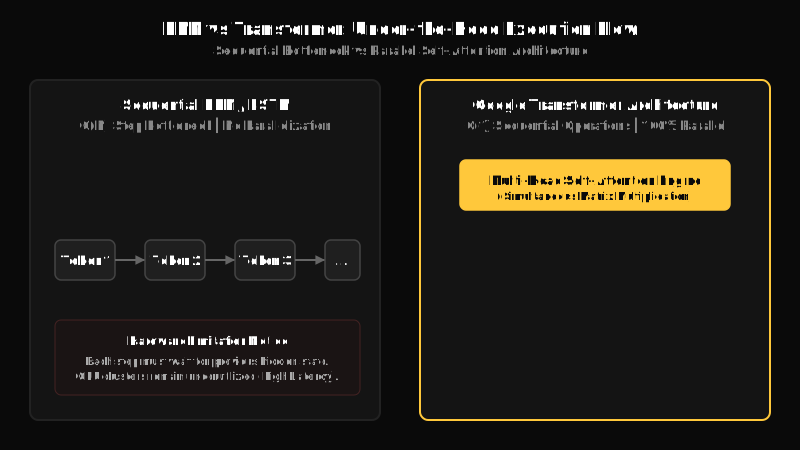
Google scientists solved this exact problem by introducing the self-attention mechanism. Instead of processing words one after another like a recurrent network, the Transformer architecture loads all the words in a sentence into memory at the exact same time through parallel processing. The self-attention mechanism mathematically calculates an attention weight between every single word and every other word in the sequence.
For example, take the sentence: "The server crashed because it was overloaded." An old recurrent network struggled to figure out whether the word "it" referred to the server or the crash. But Google's self-attention mechanism maps these relationships instantly within a high-dimensional vector space. As a result, processing speeds skyrocketed, making it incredibly easy to scale these models across massive GPU and TPU clusters. You can read more about this breakthrough in the official Google Research Blog Post.
Step-by-Step Execution Trace and Code Mechanism
When you type a prompt into ChatGPT or Gemini, how does the data actually flow under the hood? Let us trace the execution pipeline and memory layout across five distinct steps to see how the engine generates a response:
- Step 1 - Tokenization: Your input text is first broken down into smaller pieces called tokens. Each token is then mapped to a specific numerical ID that the computer can understand and manipulate.
- Step 2 - Embedding and Positional Encoding: Since the Transformer architecture processes all words in parallel, it needs a way to remember word order. Google scientists solved this using positional encoding. A mathematical signature representing the word's position in the sentence is added to each token's embedding vector, creating a rich, high-dimensional representation.
- Step 3 - Multi-Head Self-Attention: This is Google's core architectural innovation. For each token, the model creates three distinct vectors: Query (Q), Key (K), and Value (V). Using matrix multiplication on these vectors, the model calculates how much focus, or attention, each token should pay to every other token. Multiple attention heads work in parallel to capture different aspects of the text, such as syntax, grammar, and long-term context.
- Step 4 - Feed-Forward Network and Normalization: The data flows out of the attention blocks and passes through a feed-forward neural network and layer normalization at each stage. This step refines the data representations and stabilizes the learning process.
- Step 5 - Output Generation (Softmax): Finally, the model calculates a probability distribution across every single token in its entire vocabulary. It predicts and selects the most likely next token to continue the sentence. This entire execution cycle loops thousands of times per millisecond to stream the final answer onto your screen.
Google's Mistake or Extreme Caution?
Now brings us to the biggest question: Why didn't Google release a commercial product like ChatGPT first, especially since they invented the underlying technology? Was this an engineering failure on their part? Not at all. It was primarily a conflict of corporate culture and business models.
The first factor was reputation risk and the fear of hallucinations. As a multi-billion-dollar public company, Google holds a massive amount of global trust. One well-known limitation of large language models is hallucination, where the AI presents completely false information with absolute confidence. Google leadership worried that releasing an imperfect chatbot that provided incorrect or biased answers would severely damage the credibility of their flagship search engine.
The second and most critical factor was the Innovator's Dilemma and business model cannibalization. Google makes the vast majority of its revenue from its search engine and advertising network. When you search for something on Google, you see links to different websites alongside sponsored advertisements. If Google released an AI interface that gave users direct, instant answers, people would stop clicking on website links and ad banners. Google hesitated to push a technology that could actively cannibalize its multi-billion-dollar advertising empire.
OpenAI's Entry and Masterstroke
While Google sat in analysis meetings debating model safety and revenue impact, OpenAI stepped onto the field. They recognized the true commercial potential of Google's open-source Transformer architecture. OpenAI believed firmly in a simple principle known as scaling laws. They hypothesized that if you exponentially increased the parameter count and training data of a Transformer model, advanced reasoning and logical capabilities would emerge automatically.
They methodically released the GPT-1 Technical Paper (2018) with 117 million parameters, followed by GPT-2 with 1.5 billion parameters, and the historic GPT-3 Technical Paper (2020) with 175 billion parameters. However, OpenAI's true masterstroke was not just training large models. Their smartest move was product delivery and user interface design.
When they released ChatGPT in November 2022, they did not offer a complex API or a developer-only terminal console. Instead, they launched a simple, familiar chat interface that anyone could use immediately. Everyday users could converse with the AI without needing any programming knowledge. That single UX decision caught Silicon Valley completely off guard and secured OpenAI an unbeatable first-mover advantage.
Important
UI/UX and Accessibility Advantage: No matter how powerful your underlying engineering architecture is, a technology will struggle to achieve mass adoption if it lacks a simple, intuitive user interface. The clean simplicity of the ChatGPT interface was one of the biggest catalysts for its exponential growth.
Was It Theft, or Just How Open-Source Works?
Many casual tech observers ask a fair question: If OpenAI built a multi-billion-dollar business using technology invented by Google, is that legally considered theft? From a strictly legal standpoint, the answer is no.
The code and architectural blueprints that Google published alongside their "Attention Is All You Need" paper were released under an open-source license. The fundamental principle of open-source software is that anyone is free to use, modify, and build commercial products on top of the technology. OpenAI operated entirely within normal legal and open-source boundaries.
From a business and strategy perspective, however, industry experts often call this one of the greatest idea hijacks or value capture failures in technology history. Google's scientific teams spent years and millions of dollars on research and development, yet a relatively small startup walked away with the market leadership and commercial rewards.
To make matters worse for Google, the event triggered a massive brain drain. All eight scientists who authored the original Transformer paper ended up leaving Google within a few years of ChatGPT's release. Frustrated by corporate bureaucracy and slow product timelines, they departed to launch their own successful artificial intelligence startups. For example, Ashish Vaswani and Niki Parmar founded Essential AI, Aidan Gomez founded the highly valued AI company Cohere, and Noam Shazeer founded Character.ai, a startup that Google eventually brought back into its ecosystem through a multi-billion-dollar deal.
Google's Panic Mode and the Current AI War
Within just a few weeks of launching, ChatGPT broke historical records by reaching one million, and then one hundred million active users faster than any software product in history. This unprecedented growth triggered internal panic at Google headquarters. Google CEO Sundar Pichai issued a company-wide "Code Red," calling in company founders Larry Page and Sergey Brin from retirement to help steer their AI strategy.
Realizing they had fallen behind in the race, Google rushed to release their first AI chatbot, named Bard, in early 2023. Because the launch was rushed, Bard gave a factually incorrect answer about the James Webb Space Telescope during its official demo event. That single public error caused Google's stock price to plummet, wiping out over one hundred billion dollars in market value in a single day.
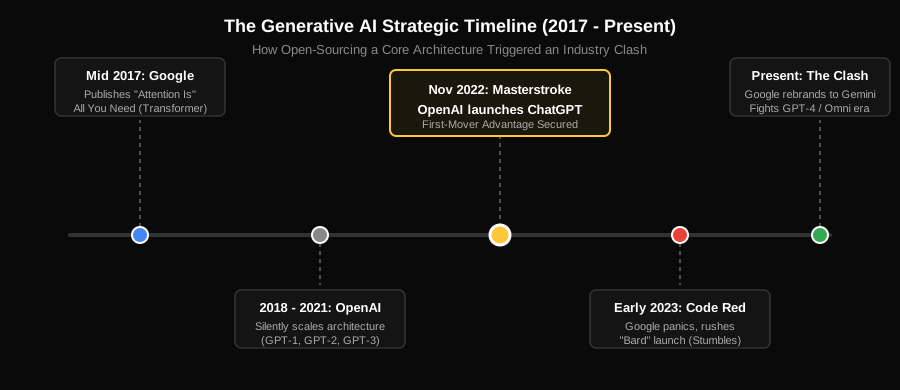
Following that rough start, Google restructured its entire artificial intelligence division. They merged their scattered AI research teams, Google Brain and DeepMind, into a single powerhouse called Google DeepMind. They retired the Bard brand completely and introduced the Gemini Technical Architecture.
Today, Google's Gemini models compete directly against OpenAI's GPT-4 and Omni architectures. Google holds a massive long-term advantage thanks to its vast data ecosystem, which includes YouTube, Search, and Android, as well as its custom Tensor Processing Unit (TPU) hardware infrastructure. They are actively using these proprietary assets to win back the market share they lost.
Warning
Analysis Paralysis and Market Timing: Waiting around for absolute perfection and zero risk in a production system can cost you your first-mover advantage entirely. In software engineering, deploying a functional product quickly to establish a real-world user feedback loop is almost always more effective than chasing static perfection in a lab.
Final Thoughts and Production Decision Rules
The story of Google doing the foundational research while OpenAI captured the commercial victory offers critical lessons for software engineers, system architects, and technology leaders. Having a brilliant idea or theoretical breakthrough does not guarantee success by itself. The real advantage comes from scaling that architecture at the right time and wrapping it in an accessible, user-friendly product.
As a software architect or developer, you can apply three core production decision rules from this deep dive to your daily engineering projects and system designs:
- Ensure Ecosystem Readiness: If you plan to open-source a core library or architectural innovation, make sure your team is prepared to build commercial products and ecosystems on top of it first. Otherwise, someone else will step in and capture the commercial value of your invention.
- Balance Ideation with Execution: Never fall into the trap of over-engineering or waiting endlessly for perfection. Deploy a Minimum Viable Product (MVP) or a basic, functional version to production as soon as possible. Real-world usage data is the best guide you have for making accurate architectural improvements over time.
- Prioritize Accessibility and User Experience: It does not matter how clean your backend code is or how fast your database queries run; if end-users cannot consume that value through a simple interface, the system will fail. Always strive to hide complex, under-the-hood engineering behind a clean, intuitive, and frictionless user interface.
References and Further Reading
If you want to explore the mathematical concepts and technical specifications of the Transformer architecture in greater detail, check out these official whitepapers and documentation links:
- Attention Is All You Need (arXiv:1706.03762): The original historic 2017 research paper published by Google that first introduced the Transformer architecture and the self-attention mechanism to the world.
- Google Research Blog: Transformer A Novel Neural Network Architecture: The official Google Brain blog post explaining the mechanics of the Transformer architecture and the benefits of parallel processing in clear, accessible terms.
- Improving Language Understanding by Generative Pre-Training (GPT-1 Paper): OpenAI's foundational paper demonstrating how to apply Google's Transformer architecture for generative pre-training and downstream fine-tuning.
- Language Models are Few-Shot Learners (GPT-3 Paper - arXiv:2005.14165): The comprehensive 175-billion parameter model paper from OpenAI that proved how scaling laws drive emergent capabilities in generative AI.
- Gemini: A Family of Highly Capable Multimodal Models (arXiv:2312.11805): The official technical report detailing Google's modern Gemini architecture, released as part of their competitive comeback against OpenAI.
- The Illustrated Transformer by Jay Alammar: One of the most popular engineering blog posts in the software community for visually understanding data flow, matrix multiplication, and multi-head attention mechanics under the hood.