How Distributed Sagas and Compensating Transactions Actually Work Under the Hood
On this page
When we leave monolithic architectures behind and move to microservices, the hardest reality we face is the complete loss of our database transactions. In a monolith, you have a single database. You can easily rely on ACID properties (Atomicity, Consistency, Isolation, Durability) to keep your data perfectly balanced. But once your system becomes distributed, with each microservice owning its own isolated database, maintaining a global transaction turns into an engineering nightmare.
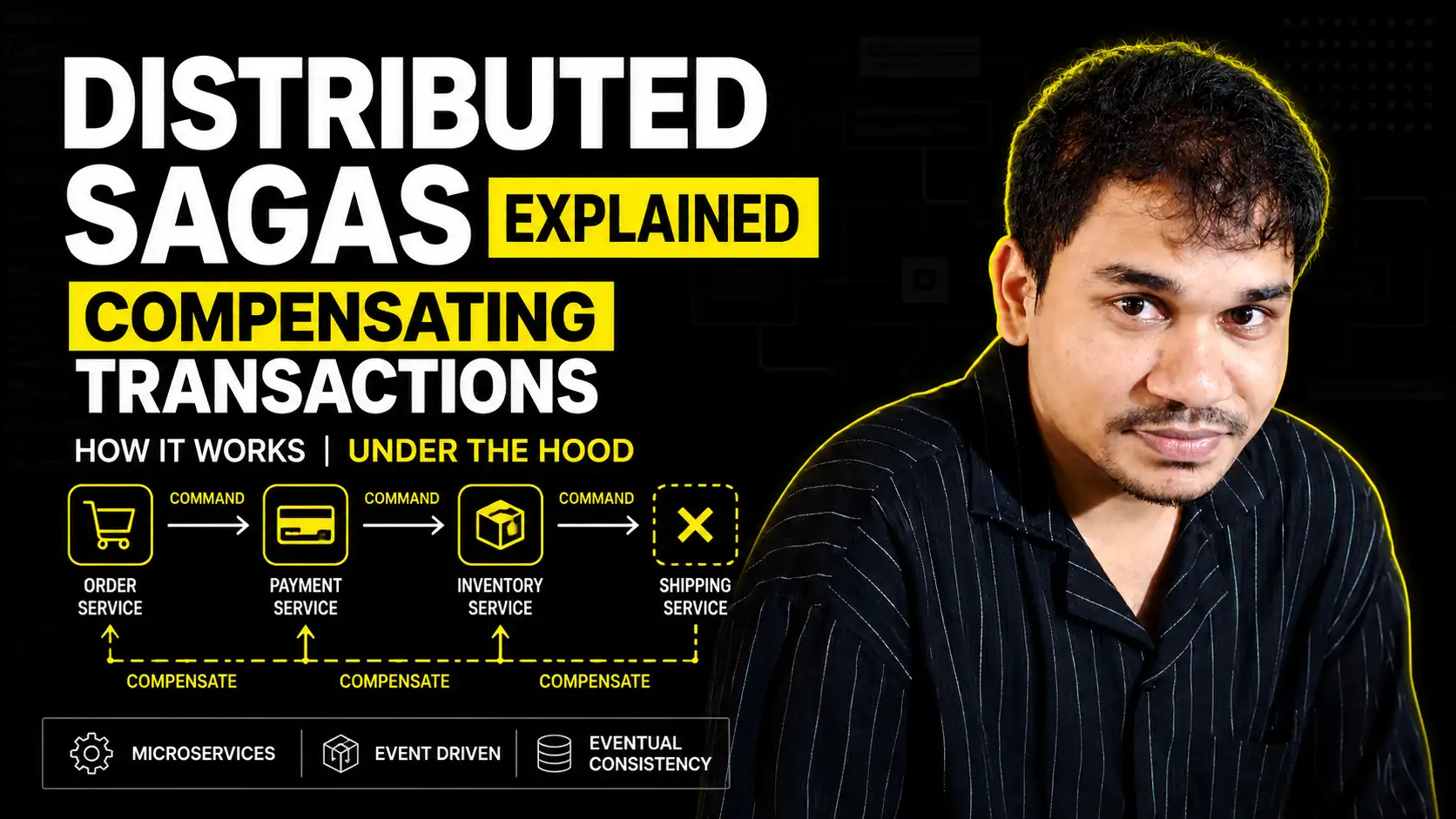
Many developers assume they can solve this problem by leaning on the traditional Two-Phase Commit, or 2PC protocol. In high-scale production realities, however, 2PC is a dead architecture. Today, we are going to treat this like a real whiteboard session. We will analyze from the lowest system levels why distributed locking mechanisms fail under load, and explore how to use Distributed Sagas and Compensating Transactions to build a resilient, production-grade state machine.
1. The Core Distributed Nightmare and Why It Matters
The biggest weakness of the Two-Phase Commit architecture is its synchronous lock trap. Under the 2PC protocol, a central coordinator tells all participating databases to get ready for a transaction during the Prepare Phase. While this happens, every single database places a distributed lock on its own local records. Those locks do not get released until the coordinator sends the final instructions during the Commit Phase. Imagine you have five microservices in your system. If just one of those services experiences a slight network hiccup and takes 200 milliseconds to respond, every database thread across your entire architecture sits there blocked for that full 200 milliseconds. In a high-throughput system, this blocking behavior drains your database connection pools in seconds, spikes your system latency, and grinds your overall throughput down to zero.
This is exactly why modern cloud-native architectures completely abandon the strict Isolation (I) property of ACID. Instead, we adopt the BASE model, which stands for Basically Available, Soft state, and Eventual consistency. In a distributed system, maintaining perfect transaction isolation across networks is mathematically and practically impossible. We simply have to accept that the system's state will remain temporarily out of sync, living in a soft state. However, we design the architecture so that after a specific window of time, all data eventually becomes consistent and balanced across every service.
This mental shift introduces a dangerous linear execution problem. Let us say you run an e-commerce order chain where data moves from the Order Service to the Payment Service, and finally to the Inventory Service. What happens if the payment succeeds, but the Inventory Service crashes or returns an out-of-stock error right after? In a monolith, you just issue a simple ROLLBACK command and everything resets. In a microservice mesh, the payment database transaction has already committed, and its previous state is wiped from memory. Because of this downstream failure, your user just got charged, but they will never receive their product. To prevent this silent data corruption, we need to implement a Distributed Saga architecture.
2. The Foundational Mental Model and Analogy
The core concept behind a Distributed Saga is both powerful and logical. Instead of wrapping an entire business process inside a global database lock, we break that process down into a sequential chain of independent local transactions. Each service performs its local work, commits the changes directly to its own database, and then publishes an asynchronous message or event. This event tells the next service in the line to wake up and start its part of the job.
To see this clearly, let us look at a familiar real-world analogy. Imagine you are booking a multi-city vacation from Dhaka to Paris through a travel agency. The package requires three separate steps: booking a flight, reserving a hotel room, and renting a car. Notice that the travel agent never locks all three company servers at the exact same time. Instead, the agent logs into the airline system first, books the flight, and grabs a confirmation token. Next, they reserve the hotel room. But when they try to rent a car, the system says no vehicles are available. Can the agent simply hack into the airline database and delete the previous booking record? Absolutely not, because that transaction is already finished and committed. What the agent actually does is send a brand new cancellation request to the hotel and the airline to undo the bookings.
In distributed systems, we call this mental framework an Eventual Consistency boundary. We know that while a transaction is actively running, our system stays in an in-flight state for a few milliseconds or seconds. We design our architecture so that only two outcomes exist: either the entire vacation package gets booked successfully, or every completed step gets systematically reversed until the system returns to its original balanced state.
3. Structural Typology: Orchestration vs Choreography (Under the Hood)
When engineering teams implement the saga pattern, they choose between two main architectural models: Orchestration and Choreography. Let us examine how both approaches behave down at the low-level memory and networking layers.
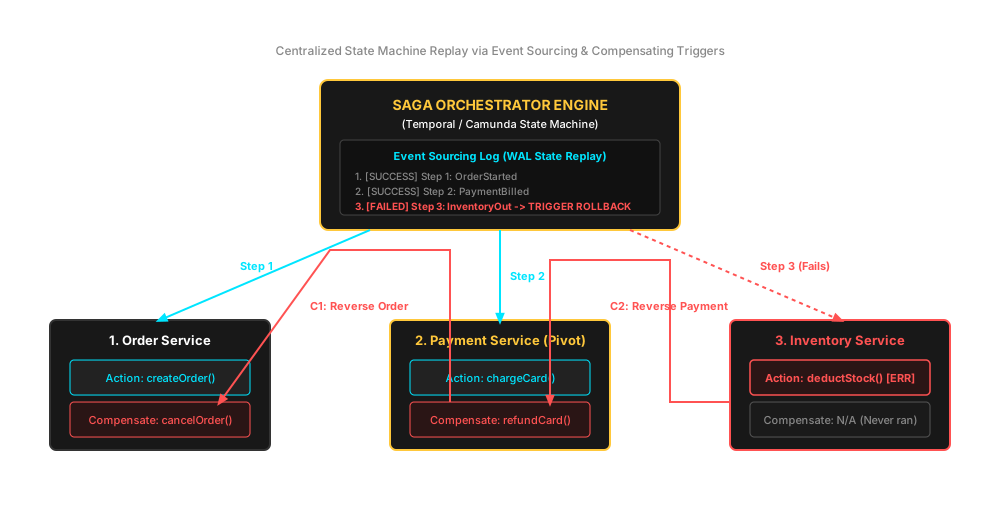
In the Orchestration model, you rely on a central brain called the Orchestrator Engine. Tools like Temporal or Camunda fit this role well. This engine maintains the entire state machine of your saga workflow inside its own memory and database. When a new order arrives, the orchestrator sends a direct command to the Payment Service. Once the payment succeeds, the response routes back to the orchestrator, which then tells the Inventory Service to deduct the stock.
Under the hood, this engine relies on a brilliant mechanism known as Event Sourcing. Imagine the orchestrator engine crashes right after the payment succeeds. When the server reboots, how does it know where the transaction left off? The orchestrator never updates its current state in place. Instead, it writes every single step sequentially to an immutable Write-Ahead Log, or event store. It records events like OrderStarted, PaymentCommandSent, and PaymentSucceeded. When the server reboots, it simply replays those event logs from zero. This completely reconstructs the in-memory state machine back to the exact millisecond before the crash occurred.
The Choreography model takes the opposite path by eliminating the central brain entirely. It is a fully decentralized, event-driven architecture. Here, every microservice listens to specific topics inside a message broker, like Kafka or RabbitMQ. When a service hears an event, it executes its local database transaction and immediately drops a new event back into the broker. For example, the Order Service emits an OrderCreated event. The Payment Service catches that event, charges the user, and emits a PaymentBilled event. Finally, the Inventory Service catches the billing event and updates its stock levels.
However, the choreography model introduces a dangerous trap known as the cyclic dependency loop dilemma. Imagine Service A sends an event to Service B, Service B sends one to Service C, and due to some routing bug or custom business logic, Service C sends an event right back to Service A. Under high traffic loads, this decentralized event chain turns into an infinite loop or distributed deadlock. It quickly floods your broker memory buffers and crashes the messaging infrastructure. Because of this risk, whenever a workflow grows beyond five services, you should always pick the Orchestration model.
4. Anatomy of a Saga Transaction: The Tri-Partition Rule
A common architectural mistake is treating every local transaction inside a saga chain equally. When you design a robust system, you must split every saga chain into three distinct failure boundaries. We call this framework the Tri-Partition Rule:
-
Compensable Transactions: These are the early steps in your saga sequence that you can easily reverse if a downstream failure happens. Placing a temporary hold on a user's bank balance or reserving items in a warehouse are classic examples. If something breaks later, you just fire a reverse command to roll these actions back.
-
The Pivot Transaction: This is the absolute critical junction of your saga workflow. Think of it as the point of no return. If your pivot transaction succeeds, the saga will never run backward. You lose the ability to perform a backward recovery or rollback. Capturing funds from a third-party payment gateway like Stripe or PayPal is a standard pivot transaction. Once the actual money leaves the customer's bank account, a simple database rollback cannot magically bring it back.
-
Retriable Transactions: These are all the downstream steps that execute immediately after the pivot transaction finishes. From an architectural standpoint, these steps are never allowed to fail permanently. Examples include sending an email receipt to the user or updating an inventory status from reserved to sold. If the notification service experiences a network drop, the saga does not trigger a rollback. Instead, it uses exponential backoff and retries the step infinitely until the task succeeds. We call this pattern forward recovery.
5. The Reverse Engine: Compensating Transactions and Recovery Patterns
When you run a ROLLBACK command in a monolithic database, the storage engine simply throws away the uncommitted pages in memory and restores the disk to its previous snapshot. You cannot do this in a microservice architecture. Your local transaction already committed to the database, and other concurrent threads might have read that data. To undo the work, you have to build a semantic rollback mechanism.
A semantic rollback is a process where you do not delete old data. Instead, you insert a brand new, opposite entry into the database called a Compensating Transaction. This new entry mathematically cancels out the effects of the original operation. For example, if your original local transaction ran UPDATE accounts SET balance = balance - 500 WHERE id = 1, your compensating transaction must run UPDATE accounts SET balance = balance + 500 WHERE id = 1. You balance the ledger by matching every debit entry with a complementary credit entry.
Saga patterns rely on two primary recovery workflows to handle errors:
-
Backward Recovery Workflow: If a step fails before you reach the pivot transaction, the system starts walking backward. Imagine your normal sequence flows through steps . If step throws an error, the orchestrator fires your compensating commands in reverse order: . Keep in mind that the step that failed, step , never gets a compensating command. Since its original action never succeeded, there is nothing to undo.
-
Forward Recovery Workflow: If an error occurs after you pass the pivot transaction, the system never walks backward. It refuses to roll back and keeps pushing forward. The orchestrator places the failed step into a retry buffer and attempts to run it again until the entire process completes from end to end.
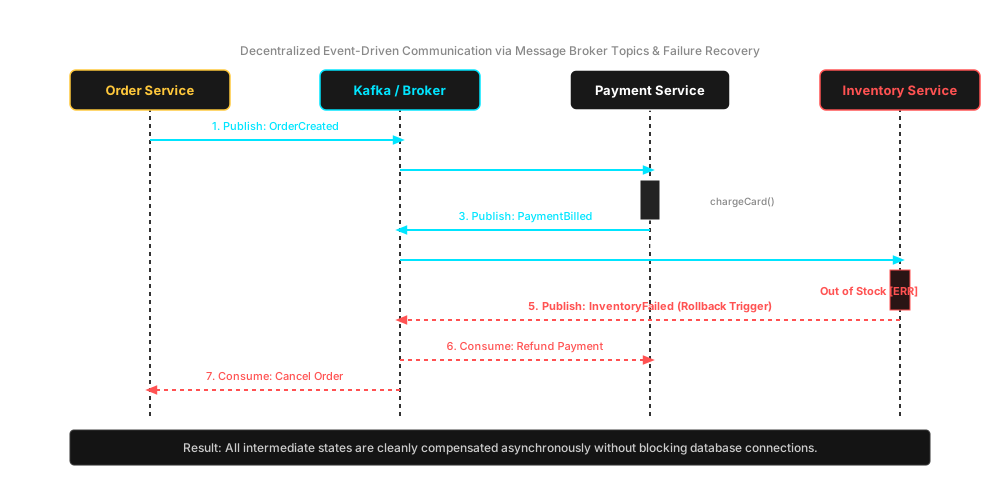
When you look at execution timelines, you can clearly trace how asynchronous events pass between microservices in parallel. The moment a downstream failure occurs, cascading reverse events immediately trigger your compensating transactions to restore system equilibrium.
6. Step-by-Step Execution Trace and Code Mechanics
To really understand how a production-grade saga orchestrator operates at the code level, let us build a clean blueprint using Node.js and TypeScript. This memory-safe coordinator engine will execute steps sequentially and automatically trigger reverse compensating functions whenever a failure occurs.
Step 1: The Orchestrator Coordinator Code Structure
We will build a class that holds an internal map of transaction steps alongside their corresponding compensating actions.
type SagaStep = {  name: string;  action: () => Promise<any>;  compensate: () => Promise<any>;};
export class SagaOrchestrator {  private steps: SagaStep[] = [];  private executedSteps: SagaStep[] = [];
  // Register a new saga step alongside its reverse compensation logic  public addStep(name: string, action: () => Promise<any>, compensate: () => Promise<any>): void {    this.steps.push({ name, action, compensate });  }
  // Execute the saga sequentially and trigger backward recovery on failure  public async execute(sagaId: string): Promise<boolean> {    console.log(`[Saga Engine] Starting Saga Execution: ${sagaId}`);
    for (const step of this.steps) {      try {        console.log(`[Saga Engine] Executing Step: ${step.name}`);        await step.action();        // Store successful steps in the execution log        this.executedSteps.push(step);      } catch (error) {        console.error(`[Saga Engine] Step Failed: ${step.name}. Triggering Backward Recovery!`, error);        await this.rollback(sagaId);        return false;      }    }
    console.log(`[Saga Engine] Saga Execution Completed Successfully: ${sagaId}`);    return true;  }
  // Execute compensating transactions in reverse order  private async rollback(sagaId: string): Promise<void> {    console.log(`[Saga Engine] Starting Rollback for Saga: ${sagaId}`);
    // Reverse the execution list to walk backward from the last successful step    const reversedSteps = [...this.executedSteps].reverse();
    for (const step of reversedSteps) {      try {        console.log(`[Saga Engine] Compensating Step: ${step.name}`);        await step.compensate();      } catch (compensateError) {        // If a compensating step fails, push it to a Dead Letter Queue (DLQ)        console.error(`[CRITICAL] Compensation Failed for Step: ${step.name}. Manual intervention required!`, compensateError);      }    }  }}
Step 2: Idempotent Compensations and Composite Key Design
In distributed environments, network hiccups mean a single compensating command, like cancelInventory, might hit your server multiple times. If your compensation logic lacks idempotency, your database will accidentally restore the stock twice. To protect against duplicate requests, you must build database guards using a unique saga identifier (saga_id) and composite keys.
import { PrismaClient } from '@prisma/client';
const prisma = new PrismaClient();
async function compensateInventory(sagaId: string, productId: string, quantity: number) {  // Check idempotency and restore inventory inside a single database transaction  return await prisma.$transaction(async (tx) => {    // 1. Verify if this specific saga ID already executed its rollback    const existingCompensation = await tx.compensation_logs.findUnique({      where: {        saga_id_step_name: {          saga_id: sagaId,          step_name: 'INVENTORY_DEDUCT_COMPENSATION',        },      },    });
    if (existingCompensation) {      console.log(`[Idempotency Guard] Compensation already processed for Saga: ${sagaId}. Skipping.`);      return;    }
    // 2. Restore the inventory stock    await tx.products.update({      where: { id: productId },      data: { stock: { increment: quantity } },    });
    // 3. Create a compensation log entry to permanently block duplicate requests    await tx.compensation_logs.create({      data: {        saga_id: sagaId,        step_name: 'INVENTORY_DEDUCT_COMPENSATION',        processed_at: new Date(),      },    });
    console.log(`[Saga Engine] Inventory successfully restored for Product: ${productId}`);  });}
7. Distributed Isolation Anomalies: The Hidden Traps
Because saga patterns lack a global database lock, intermediate or partial system states sit out in the open where concurrent transactions can read them. This complete lack of transaction isolation creates serious concurrency anomalies and system traps:
- Lost Updates: Suppose Saga A checks a user's credit limit and temporarily reduces it by 100 dollars. At the exact same moment, Saga B jumps in and updates that same user's credit limit. If Saga A fails later and triggers a rollback, its compensating command will overwrite the changes made by Saga B. As a result, the update from Saga B is permanently lost.
- Dirty Reads: Imagine a saga is sitting halfway through its workflow, where payment succeeded but inventory verification is still pending. A second user sees that uncommitted product sitting in stock and places an order. A moment later, the original saga fails and triggers a rollback. That second user just ordered an item that never actually existed in the warehouse.
To eliminate these isolation problems, you have to build specific architectural countermeasures into your production system:
-
Semantic Lock: Instead of relying on low-level database engine locks, you build application-level locks directly into your business logic. For example, instead of immediately setting an order status to
ACTIVE, you use intermediate states likePENDING_CHECKOUT,RESERVED, orLOCK_ACQUIRED. When other transactions attempt to read that record, the status tells them a saga is actively modifying the data, and they know to leave it alone. -
Pessimistic View: You design your read-heavy APIs to always display a conservative or pessimistic view of the system state. When showing a user's account balance, for instance, you subtract the
Reserved Balancefrom theActual Balanceand only display theAvailable Balance. This guarantees that even if a running saga fails and rolls back later, the user never experiences a jarring UI glitch or data discrepancy.
8. Production Warnings & Safety Nets
The Infinite Rollback Loop
You must ensure your compensating transaction functions never throw unhandled exceptions. If a rollback function crashes due to a database connection error or a bug in your business logic, the entire orchestrator gets trapped in an infinite retry loop. This leaves your data permanently unbalanced. Always write fault-tolerant compensation logic, and use a Dead Letter Queue (DLQ) as your final safety net.
Asynchronous Deadlocks in Choreography
Never design cyclic dependencies inside a choreography saga. If Service A sends an event to Service B, Service B sends to Service C, and Service C routes back to Service A, you are asking for trouble. During traffic spikes, this circular loop creates distributed deadlocks that overflow message broker buffers and crash your network. Keep your event flows strictly unidirectional or organized in a clear tree structure.
9. Summary & Production Decision Rules
This deep dive shows us that a distributed saga is much more than a simple coding trick. It represents a fundamental paradigm shift in system architecture. To successfully apply this pattern in your production environments, stick to these core decision rules:
- Architectural Selection Framework: If your system relies on two to four microservices with simple, linear workflows, use the Choreography model. However, if your architecture spans more than five services, or involves complex conditional logic and strict timeouts, pick an Orchestration engine like Temporal without hesitation. Debugging large-scale saga failures without central visibility is practically impossible.
- Release and Tracking Mechanisms: Once you deploy a distributed saga architecture to production, building full observability is mandatory. Generate a unique
trace_idorsaga_idat the very start of every user request. Use tools like OpenTelemetry to propagate that identifier across every microservice log and event payload. If a transaction fails in production, your distributed tracing dashboard will let you pinpoint the exact service and root cause behind the rollback in seconds.
When you master these low-level distributed mechanisms and build them cleanly into your production architecture, your system will handle network failures and heavy concurrency loads effortlessly.