OOP vs Functional Programming Architectural Trade-offs
On this page
When working on scaled production systems, you might have noticed a common pattern. In large projects, nearly 80 percent of critical bugs come from internal state mutations and uncontrolled side effects within objects. Developers often mistake Object-Oriented Programming (OOP) and Functional Programming (FP) as just a cultural war or a syntax choice. The real difference is not in the syntax. The core difference lies in how these two paradigms handle memory, state variability, and control flow. Making the wrong state management choice can introduce concurrency race conditions, heavy garbage collection pressure, and scalability bottlenecks into your system. The main goal of this deep dive is to look past the dogma and break down the under-the-hood memory and architectural workflows. This will give you a clear guideline to make the right design decisions for your project.
1. The Foundational Mental Model and Analogy
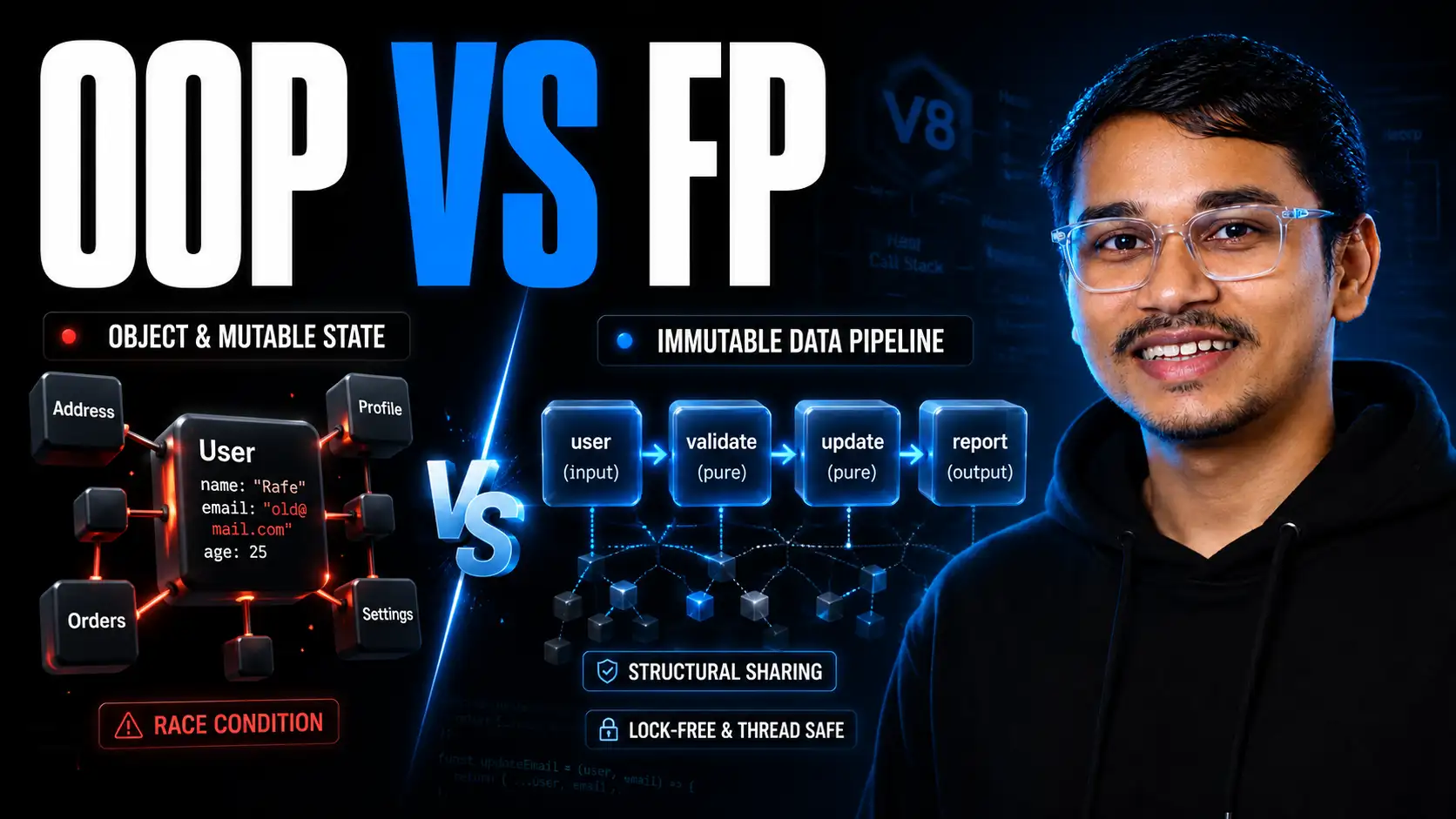
Before jumping into low-level architecture, we need to understand the high-level theory of state and transformation. You can think of the OOP mental model as an independent entity or a bank vault. The data is locked inside this vault, and you can only change the internal state through specific methods or interfaces. On the other hand, the FP mental model is like an assembly line or a water purifier. Data flows through this pipeline, and instead of modifying the existing data, each function generates and outputs data in a completely new format.
To make this clearer, we can use a real-world analogy. For OOP, think of a smart car class. The car's gear, engine, and current speed are its internal private state. You can call an accelerate method, but you cannot go directly into memory and change the speed value yourself. The car manages its own state. For FP, imagine a digital passport validation pipeline. The original passport always remains exactly the same, completely immutable. The validation functions read the passport as an input and return a new validation report without modifying the original document. The data flows, but the original source of truth never mutates.
2. Under-The-Hood Architecture (The Core Deep Dive)
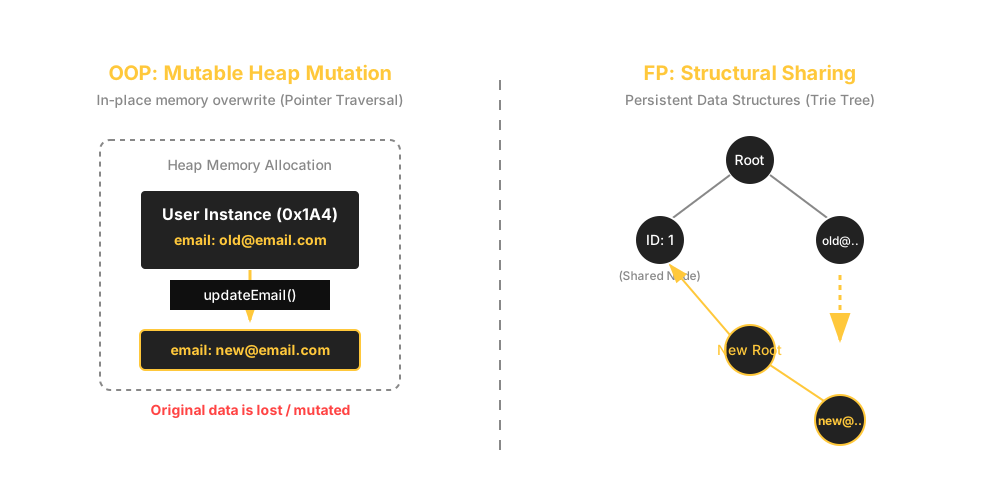
Now let us break down how memory allocation and execution models work at the engine level. Under the hood, OOP relies on heap allocation, object reference graphs, and pointer traversal. When you create an object, the engine allocates a block of memory in the heap. Later, when you change its state, the engine uses the pointer to write directly in place within that memory. To boost performance, modern runtimes like the V8 engine use inline caches and Vtables to optimize these method calls.
The under-the-hood mechanism of FP is entirely different. It relies heavily on immutable data structures and structural sharing. When you update a state, FP does not copy the entire memory block. Instead, it uses persistent data structures like Trie trees. The engine only allocates new memory for the specific nodes that changed, while the unchanged nodes share their previous references. Combined with pure functions and call stack frames, this creates an architecture where no function knows about the state outside of itself.
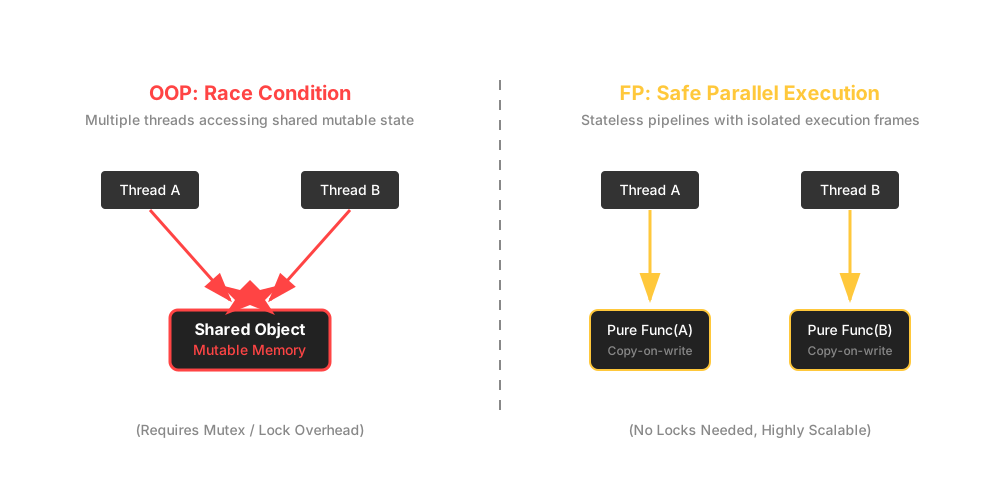
When it comes to concurrency and thread safety mechanics, this architectural difference has a massive impact. Because OOP relies on shared mutable state, race conditions occur when multiple threads try to write to the same memory reference at the same time. To prevent this, you have to use locks or mutexes, which severely increases latency. FP, however, uses stateless flow and immutable data to guarantee zero side effects. As a result, you can easily achieve lock-free thread safety and safe parallel execution.
3. Step-by-Step Execution Trace and Code Mechanics
To understand how these architectural concepts work at the code level, we will analyze the execution trace of a user email update.
First, consider Scenario A, the OOP state mutation execution trace. When you call new User(), the engine allocates memory in the heap and creates an instance. Then, you invoke the user.updateEmail("new@email.com") method. At this exact moment, an execution context is created in the call stack, and the engine resolves the actual field in heap memory using the this pointer. The engine performs a direct in-place memory write, meaning the original data is mutated. If there is a database sync call inside this setter, it triggers a side effect. Later on, debugging or backtracking this side effect becomes incredibly difficult because the historical state no longer exists in memory.
Now look at Scenario B, the FP immutable transformation execution trace. Here, the original user object sits in memory completely frozen and immutable. When you call the pure function updateEmail(user, "new@email.com"), a completely isolated execution frame is created in the call stack. The engine uses structural sharing to create a new reference only for the email field that changed, reusing the rest of the fields from the old object. Finally, the function returns the new immutable object. Zero memory collisions happen here, and the return value of the function is always reproducible.
Important
The main strength of OOP is encapsulation. But when multiple services call methods on the same class and change its internal state, it turns into shared mutable state. This shared state is the leading cause of race conditions in distributed systems.
Warning
Immutability in FP makes your code extremely predictable. However, if you are not careful with excessive object allocations and copy-on-write patterns, you can introduce high garbage collection overhead and pause times in high-throughput systems. This will cause noticeable latency spikes.
4. Edge Cases, Pitfalls, and Trade-offs
Every system architecture has a trade-off between performance and maintainability. In FP, constantly creating new objects increases the memory allocation rate, which puts heavy pressure on garbage collection. While persistent data structures and structural sharing reduce this overhead significantly, it can still be an issue for highly memory-sensitive or CPU-bound algorithms. In those specific cases, in-place mutation or an imperative approach performs much faster.
On the flip side, the biggest trap in OOP is deep inheritance hell or tightly coupled object relationships. Joe Armstrong famously called this the banana-gorilla problem, where trying to extract a simple object forces you to pull in its entire environment. Contrast this with FP, where concepts like monads or currying are incredibly powerful, but their steep learning curve can make onboarding a new team very challenging. As an architect, you have to look at the size of your project, your team's capability, and your scalability requirements before making a decision.
Tip
The architectural sweet spot: Use Domain-Driven Design (OOP) for module levels and service boundaries. This keeps your structure clean. Then, use pure functions (FP) for the internal business logic and data processing within those services.
5. Practical Use-Case Decision Matrix and Summary
In modern architecture, the days of blindly following a single paradigm are over. You need to take a hybrid approach based on your actual requirements. Here is a quick decision matrix to help you choose:
- GUI, Game Engines, and Complex Domain Entities: Use OOP here. It is the most natural fit to encapsulate the interactive object's state, lifecycle, and in-place memory update methods all together.
- Data Pipelines, ETL, and Analytics Infrastructure: Use FP here. In data stream transformations, pure functions and immutability completely remove side effects and make pipelining much easier.
- High-Concurrency and Distributed Microservices: FP architecture performs best here as well. Without shared state, thread safety is guaranteed, and parallel processing is possible without deadlocks or race conditions.
- Enterprise Business Applications (CRUD / Domain Boundary): The hybrid pattern is the most effective approach here. You should use OOP modules for domain boundaries and dependency injection, and FP principles for internal business transformations.
The multiparadigm approach is now the core foundation of modern engineering. Modern languages like TypeScript, Rust, and Kotlin beautifully merge the best concepts of both OOP and FP. So, when setting up your project architecture, use OOP at the macro level to define service interfaces, and use FP at the micro level for data transformation.
Finally, as an engineer, ask yourself three questions whenever you make an architectural decision. First, are you building a system where the state of complex entities needs to be updated in-place frequently? Second, is high concurrency and multi-threaded processing a top priority in your application? Third, what is the learning curve and maintainability capacity of your team? Answering these questions will guide you directly to the right architectural paradigm.