AI Model Routing Handbook: Which Model to Use for Which Task, and How to Decide

On this page
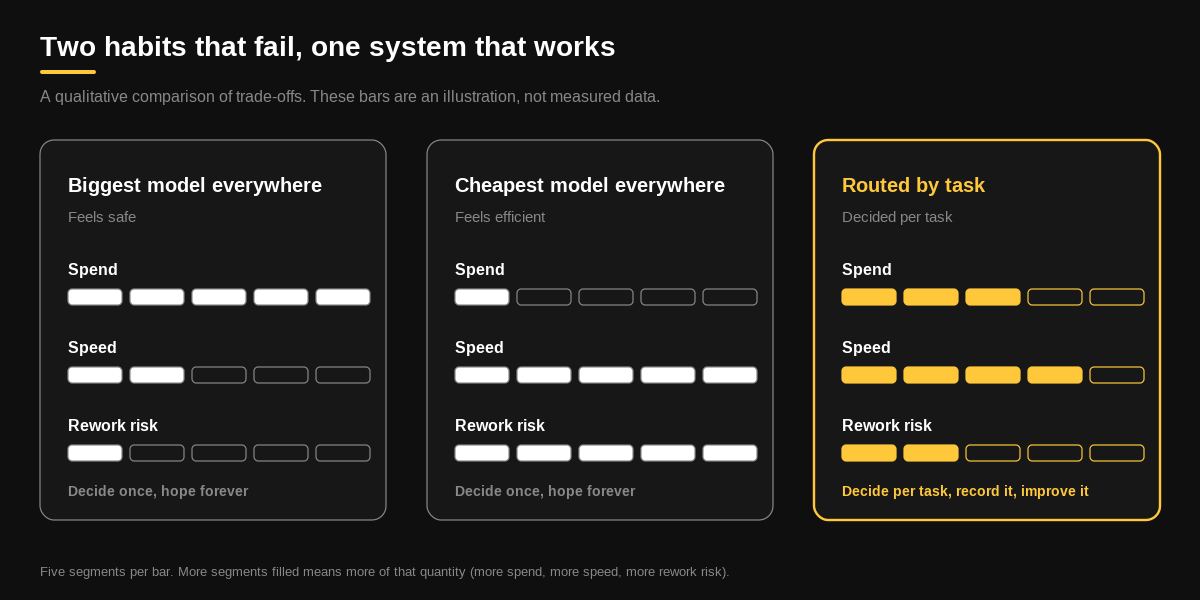
Imagine your engineering team just kicked off a new feature. In the first week, everyone defaulted to the largest, most expensive flagship model because nobody wanted to risk mistakes. At the end of the week, the API bill arrived, leaving the room silent. In the next sprint, the team swung to the opposite extreme, mandating the cheapest model for everything. The bill dropped dramatically, but an architectural flaw slipped past review into production. The engineering hours required to untangle that mistake far exceeded whatever was saved on the model bill. This is a hypothetical scenario, but you have likely witnessed some variation of it firsthand.
Both mistakes stem from the identical root cause: treating model selection as an unconscious habit rather than a conscious architectural decision. Today, the cost of that habit is steeper than ever because the price delta across tiers is enormous. According to Anthropic's documentation (opens in a new tab), Claude Opus 5.5 costs $1 per million input tokens and $10 per million output tokens, while Haiku 5.5 costs $1.10 and $1.50. That is a 40x price difference. On top of that sits the naming churn. When OpenAI released the GPT-6 family (Sol and Luna) on September 22, 2026, several industry writeups claimed there was no Terra tier; yet by October 26, GPT-6.1 Terra (opens in a new tab) surfaced across ChatGPT Work and Codex. Any static list of 'the best model' published today will be obsolete next month.
A third issue is even more deceptive. LLM outputs look polished on the surface, tempting us to accept them without verification. In an independent review (opens in a new tab) of Gemini 4 Argon, the author requested a Kubernetes manifest for an nginx deployment twelve separate times. Every single manifest passed static linting, yet not one ran successfully on a live k3s cluster; all twelve entered CrashLoopBackOff. While that represents one reviewer's focused trial rather than a definitive industry benchmark, the takeaway applies universally across all providers: looking syntactically correct is not the same as actually working.
The goal of this handbook is not memorizing model brand names. The objective is giving you an operational system to decide, for any engineering task, in any given month: which model, at what reasoning effort, and under whose supervision. This guide is paired with a companion GitHub repository (opens in a new tab) containing ready-to-use Routing Cards, evaluation templates, escalation rules, an AGENTS.md starter kit, phase-by-phase prompt templates, and an interactive cost calculator. Do not just read through this guide; at the end of each step, grab the corresponding template from the repo and integrate it into your active codebase.
Editorial Transparency
Where figures cite official vendor documentation or independent benchmarks, direct sources are linked. Where numbers are estimates, they are explicitly labeled as hypothetical calculations. I have not run independent lab benchmarks inside Codex or Antigravity, so I do not claim proprietary benchmark data under my own name. Last updated: November 7, 2026.
Table of Contents
- Step 1: Harness and Model Are Two Distinct Decisions
- Step 2: The Five Axes of Model Evaluation, and Today's Snapshot
- Step 3: The Bengali Token Tax
- Step 4: Routing Across the Project Lifecycle
- Step 5: The Decision Matrix
- Step 6: Planner, Executor, and Reviewer
- Step 7: Escalation Rules
- Step 8: Context Hygiene and Handoff Packets
- Step 9: Cost per Accepted Output
- Step 10: Verification, From "Looks Right" to "Actually Runs"
- Step 11: An End-to-End Walkthrough
- Step 12: A 30-Minute Routine for Evaluating New Models
- Recap and Production Checklist
- Sources and Limitations
Step 1: Harness and Model Are Two Distinct Decisions
Consider a commercial kitchen analogy. The harness is the kitchen itself: the stoves, timers, safety protocols, and prep stations. The model is the chef who actually prepares the dish. The same chef will produce vastly different results depending on the kitchen tools available; conversely, swapping chefs in the same kitchen alters the dish completely. Claude Code, Codex, and Antigravity are three distinct kitchens, while Claude, GPT-6, and Gemini 4 represent the families of chefs operating inside them. The foundational step of model routing is separating these two decisions: which harness hosts your workflow, and which model (at what reasoning effort) operates inside that harness.
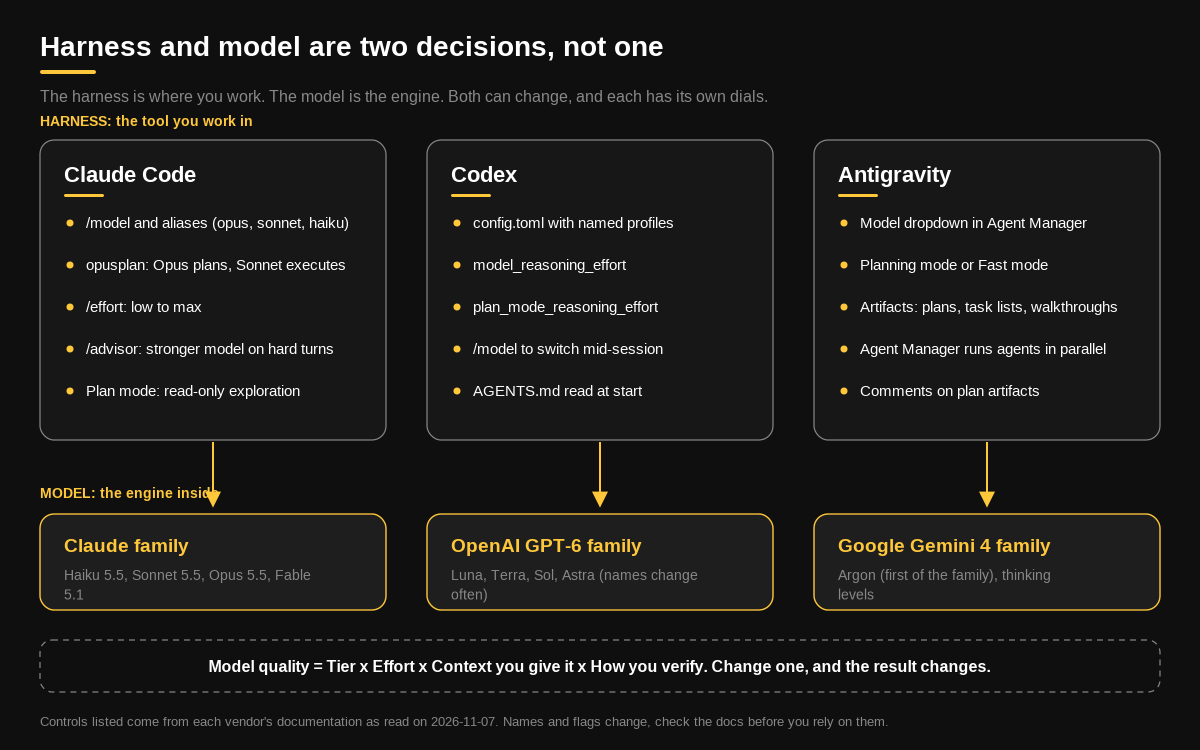
Every harness provides its own set of control dials, and understanding them constitutes half of the routing puzzle. According to Claude Code's Model Configuration Documentation (opens in a new tab), you can specify model aliases like opus, sonnet, and haiku, as well as a specialized alias called opusplan that pairs Opus during planning mode with Sonnet during execution. The /effort command allows dynamic adjustment of reasoning depth. In addition, Claude Code offers /advisor (opens in a new tab), a pattern where a faster, cost-effective model drives execution while consulting a heavier model during critical architectural forks. Per Anthropic's documentation, this approach typically lowers net spend compared to running a flagship model continuously, though efficacy varies by task.
In Codex, configuration centers on the ~/.codex/config.toml file. Per the Codex Documentation (opens in a new tab), you can configure model and model_reasoning_effort, while using [profiles.<name>] blocks to define named profiles switchable via codex --profile <name>. The Sample Configuration (opens in a new tab) notes that you can also tune plan_mode_reasoning_effort independently for planning phases. Inside Antigravity, the Agent Manager exposes a model dropdown alongside Planning Mode versus Fast Mode toggles. According to OpenReplay's technical walkthrough (opens in a new tab), Planning Mode mandates structured implementation plans and artifact generation before executing changes, whereas Fast Mode jumps straight into code execution.
Flags and Commands Evolve Rapidly
The configuration parameters cited above reflect documentation current as of November 2026. Third-party analyses note that Codex profile syntax has shifted across minor revisions, and some Antigravity behaviors reflect its early preview builds. Always check upstream official documentation before committing configuration defaults to your team setup.
Action for Step 1: For each agent harness your team relies on, answer three operational questions: Which dial changes the underlying model? Which dial controls reasoning effort? Can planning and execution run on separate model tiers? The companion repository provides starter configurations for Claude Code, Codex, and Gemini in its templates/ folder.
Step 2: The Five Axes of Model Evaluation, and Today's Snapshot
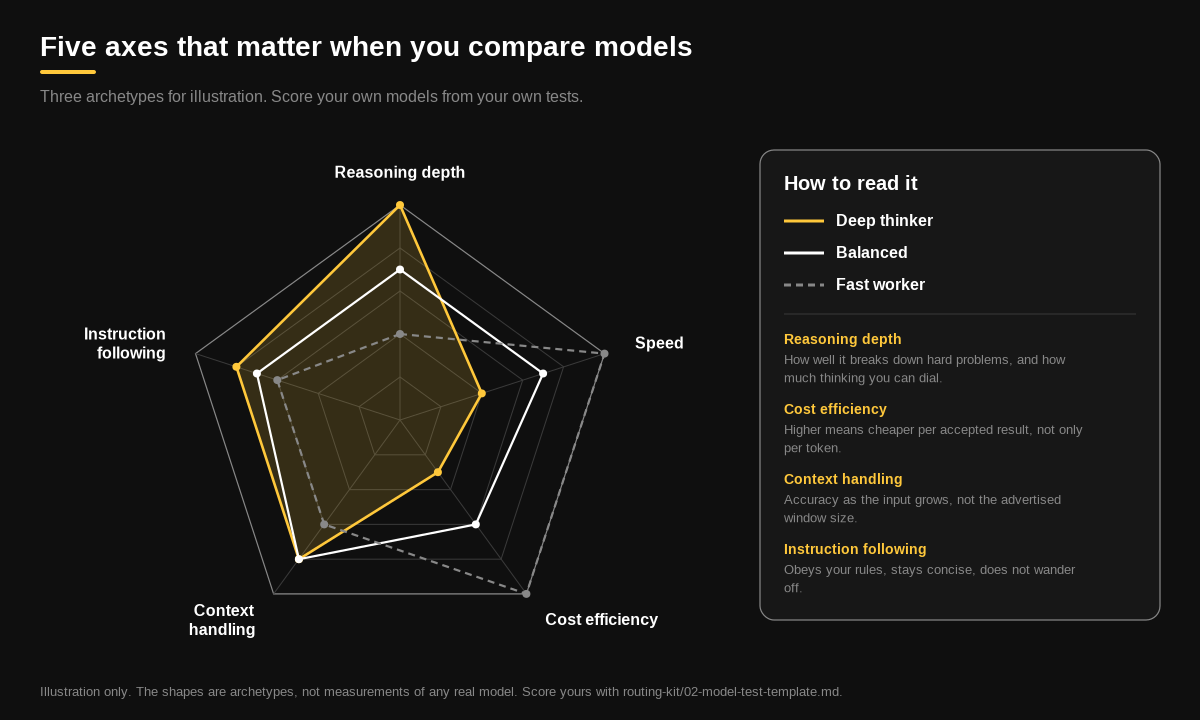
When comparing models, engineers frequently collapse evaluation into a single metric: the vendor benchmark leaderboard score. But a single scalar cannot inform task assignment. I propose evaluating models across five distinct operational axes:
- Reasoning Depth: How rigorously can the model decompose ambiguous, multi-variable problems, and how granularly can you steer its chain-of-thought thinking?
- Speed: Latency per response turn, which compounds exponentially inside automated agent execution loops.
- Cost Efficiency: Not merely nominal token rates, but total capital spent to reach a verified, accepted output.
- Context Handling: How robustly retrieval accuracy, instruction adherence, and coherence hold as prompt history expands toward limits.
- Instruction Following: How reliably the model adheres to negative constraints without hallucinating phantom dependencies or generating extraneous refactors.
Let us examine the practical landscape current through November 7, 2026. Figures for Claude derive from Anthropic's official documentation; OpenAI rates cite pricing tables from independent industry reports (opens in a new tab); and Argon metrics come from a published review (opens in a new tab) cross-referencing Google's developer tier pricing.
| Model | Input / Output (per 1M Tokens) | Context Window | Notes |
|---|---|---|---|
| Claude Haiku 5.5 | $1.10 / $1.50 | 1M | Lowest cost Claude tier |
| Claude Sonnet 5.5 | $1 / $10 | 1M | Balanced throughput and reasoning |
| Claude Opus 5.5 | $1 / $10 | 1M | Complex architectural reasoning |
| Claude Fable 5.1 | $10 / $10 | 1M | Frontier tier above Opus |
| GPT-6 Luna | $1.10 / $1.50 | 1.05M | OpenAI economy tier |
| GPT-6.1 Terra | $1 / $1 | 1.05M | Mid-range utility tier |
| GPT-6.1 Sol | $1 / $10 | 1.05M | Coding and autonomous agent focus |
| GPT-6 Astra | $10 / $10 | 1.05M | Frontier tier above Sol |
| Gemini 4 Argon | $1 / $10 (Introductory) | 1,048,576 | Thinking settings: low, medium, high |
Argon Introductory Pricing Window
Independent benchmarks highlight that Google designated $1 / $10 as an introductory rate, scheduled to transition to $1 / $10 on December 1, 2026. Cost calculations modeled today may double in baseline rates after that date.
This overview yields a significant insight: virtually every major tier now offers roughly 1 million tokens of context window. Therefore, context window capacity alone is no longer an actionable differentiator. Decisions now pivot on cost, reasoning depth, execution speed, and behavioral reliability. Furthermore, thinking tokens are billed as output tokens. In Argon benchmarks, running at the high thinking setting consumed approximately three internal thinking tokens for every single visible output token. While that represents an empirical data point from one harness, the implication is clear: adjusting your reasoning effort dial can impact your monthly invoice more dramatically than switching model tiers.
Vendor benchmark claims also demand caution. In published model cards, Argon posted a 68.9% Vals Index score against Opus 5.5 at 67.0%, Fable 5.1 at 65.8%, and Astra at 63.1%. However, that comparison evaluated only three competitor models and measured Argon exclusively at maximum reasoning effort. A 2 to 3 point lead on a public evaluation suite can easily invert within your proprietary codebase. That reality is the core rationale for model routing: vendor benchmarks decide which candidates you benchmark internally, never which model you deploy blindly.
The Steep Marginal Cost of Frontier Reasoning
A technical analysis (opens in a new tab) reviewing internal Anthropic evaluation metrics revealed that deploying Fable 5.1 as an advisor to Opus 5.5 yielded a 1.7 point accuracy lift while increasing execution cost by 2.1x. The final percentile points of model reasoning are always the most expensive.
Action for Step 2: Open routing-kit/02-model-test-template.md from the companion repository, select three representative tasks from your repository (simple, moderate, complex), and grade each candidate model on a 1-to-5 scale across all five axes.
Step 3: The Bengali Token Tax
This consideration is especially relevant for developers authoring prompts in non-Latin scripts such as Bengali or managing multilingual pipelines. Large language models process and bill text via tokens rather than raw character counts. However, the exact same sentence tokenizes into vastly different token volumes across different languages. In a foundational NeurIPS 2023 paper (opens in a new tab), Petrov and colleagues demonstrated that identical translated text can exhibit tokenization inflation of up to 15x across lower-resource languages, a disparity that persists even in modern multilingual tokenizers. The direct consequences are threefold: higher dollar costs per task, increased generation latency, and reduced effective capacity inside the context window.
Prudence is essential here. That empirical study evaluated 2023 tokenizers, and I do not have proprietary tokenization ratios for frontier Claude, GPT-6, or Gemini 4 tokenizers in Bengali, so I will not fabricate arbitrary multipliers. The good news is that you can measure your specific overhead in five minutes: transmit the exact same technical paragraph in English and Bengali to your active provider API, inspect the usage payload for input token count, and divide the two numbers. That ratio represents your operational 'Token Tax.' The companion repository provides a testing protocol and recording sheet in routing-kit/08-token-tax-experiment.md.
Quantifying this ratio informs practical architecture decisions. If tokenization inflation is substantial, authoring system instructions, architectural specs, and AGENTS.md in English while emitting user-facing copy in Bengali dramatically cuts token burn without compromising content. This is precisely why the prompt templates accompanying this handbook are written in English.
English Prompts Do Not Guarantee Superior Output
Token economy is a structural cost factor; reasoning quality is a separate dimension. The NeurIPS research measures token expansion, not downstream comprehension. Run parallel English and Bengali prompts against your specific domain to verify output quality directly.
Step 4: Routing Across the Project Lifecycle
Software engineering is rarely just typing code; a feature traverses eight distinct lifecycle phases, and the cost of an uncaught mistake varies drastically by phase. To avoid fragile model coupling, I structure routing around three abstracted tiers: Strong, Balanced, and Fast.
- Strong: Frontier reasoning models (for example, Opus 5.5, Fable 5.1, GPT-6 Astra, or Argon on
higheffort). - Balanced: The primary engineering workhorses offering balanced speed and reasoning (Sonnet 5.5, GPT-6.1 Sol, Argon on
medium). - Fast: High-throughput, low-latency models for structured transformations (Haiku 5.5, GPT-6 Luna).
Abstracting via tiers ensures your workflow survives upstream model releases: when new models drop, you update the tier mapping rather than rewriting your engineering runbooks.
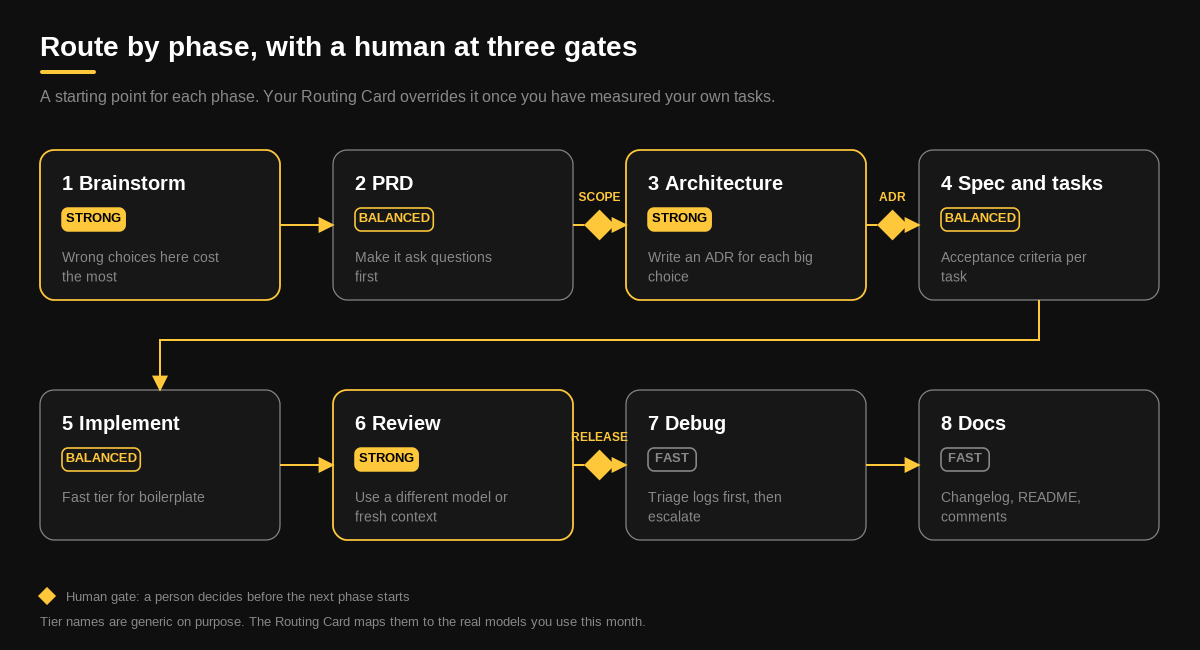
Here is the operational baseline I recommend as an initial starting point. This is not dogma; it is an architectural scaffold to calibrate against your team's test results:
- Brainstorming and Architecture (Strong Tier): Flawed design decisions compound downstream into massive refactoring costs.
- PRD and Specification (Balanced Tier): Prompt the model to ask clarifying questions before drafting assumptions.
- Implementation (Balanced Tier for core logic, Fast Tier for boilerplate): If the spec is unambiguous, balanced models execute cleanly.
- Code and Security Review (Strong Tier): Preferably using an independent model family from the one that generated the code.
- Debugging (Fast Tier triage first, escalating to Strong): Use fast models to summarize logs and isolate failure vectors before pulling in expensive reasoning.
- Documentation and Changelogs (Fast Tier): Pure summarization and documentation work well on economy tiers.
Across these eight phases, anchor three mandatory Human Gates: after scope finalization, after major architectural decisions (ADRs), and prior to production release. A Human Gate pauses automated agent execution, requiring explicit engineer signoff. The economics are straightforward: catching a flawed design assumption before code is written costs minutes; fixing it post-release costs sprints.
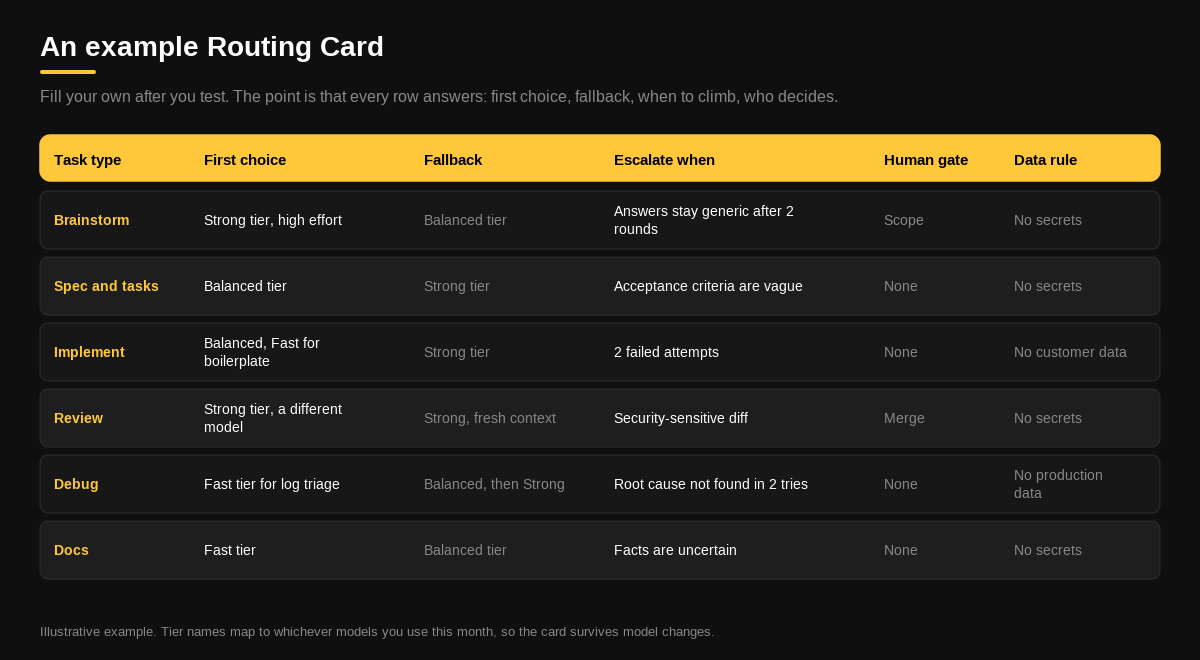
Action for Step 4: Access routing-kit/01-routing-card.md in the repository, duplicate the blank routing card template, and define your team's default model tier, fallback option, escalation criteria, and human signoff gates for each phase.
Step 5: The Decision Matrix
While a lifecycle pipeline is clean on paper, ad-hoc tasks frequently land outside structured sprints. In those moments, you need a heuristic you can evaluate in thirty seconds. I evaluate two diagnostic questions:
- Reversibility and blast radius: How difficult or expensive is it to roll back if the model makes a critical error?
- Ambiguity: How complete, specific, and unambiguous is the written specification?
Crossing these two variables generates a 2x2 Decision Matrix with distinct execution protocols for each quadrant.
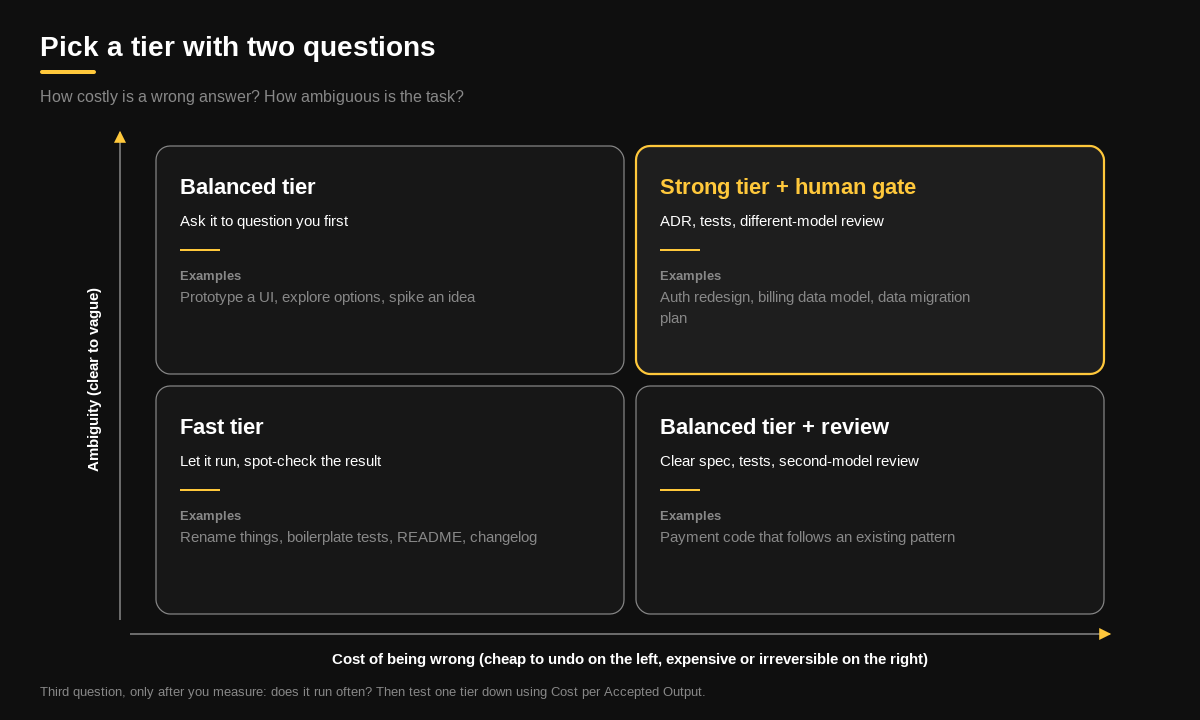
- Clear Spec + High Reversibility (Low Blast Radius): Route to the Fast Tier (symbol renames, boilerplate unit tests, documentation updates). Quick human skim upon completion.
- Ambiguous Spec + High Reversibility (Low Blast Radius): Route to the Balanced Tier (exploratory UI prototypes, design ideation). Direct the model to interview you with clarifying questions before writing code.
- Clear Spec + Low Reversibility (High Blast Radius): Route to the Balanced Tier, backed by strict automated test coverage and independent peer review (implementing payment webhooks matching existing internal patterns).
- Ambiguous Spec + Low Reversibility (High Blast Radius): Mandatory Strong Tier, formal Architecture Decision Records (ADR), and explicit human approval gates (redesigning multi-tenant auth or database schemas).
A third operational variable applies when dealing with scheduled, high-volume agent tasks: execution frequency. When a routine executes hundreds of times daily, stepping down one model tier yields substantial cost savings. However, before downgrading, always audit Step 9's Cost per Accepted Output: if a cheaper tier requires multiple failed retry loops, the apparent savings invert into net losses.
Step 6: Planner, Executor, and Reviewer
A construction site analogy illustrates this division of labor. An architect drafts the blueprints, a general contractor builds the structure, and an independent inspector verifies compliance. When a single individual performs all three functions, the inspection loses validity because people struggle to spot blind spots in their own work. Language models exhibit an identical vulnerability supported by empirical research. In a NeurIPS 2024 paper (opens in a new tab), Panickssery et al. evaluated models including GPT-4 and Llama 2, discovering that when models evaluated text authored by themselves versus others, they systematically exhibited self-preference bias, rating their own outputs higher. Furthermore, this self-preference scaled linearly with the model's ability to recognize its own generations.
This research carries caveats: it evaluated earlier generation models, not frontier Claude 5.5 or GPT-6. Do not treat it as an ironclad universal law, but rather as an architectural reason to decouple your review pipeline, using an independent model family or at minimum a clean context window. Validate in your internal evaluations whether a secondary model actually catches subtle flaws missed by the authoring model.
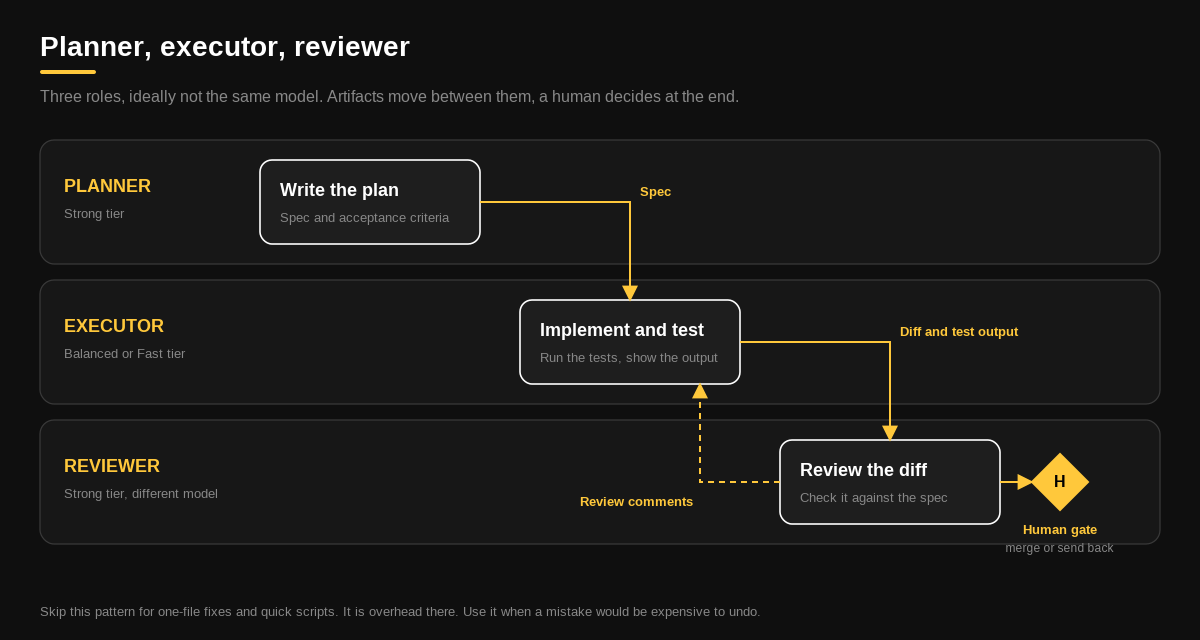
Modern developer harnesses increasingly codify this multi-agent pattern natively:
- Claude Code: The
opusplanalias pairs Opus during the planning phase with Sonnet during execution, while/advisorconsults a flagship model at pivotal checkpoints. - Codex: Supports dedicated
plan_mode_reasoning_effortoverrides to apply heavy reasoning during plan formulation while executing with leaner profiles. - Antigravity: Planning Mode mandates generating Implementation Plans and Task List artifacts, supporting inline developer comments before execution begins.
This pattern is not an ad-hoc invention; it is the deliberate orchestration of existing harness capabilities.
Avoid Over-Engineering Trivial Tasks
Deploying a three-role agent pipeline for a one-line bugfix or a five-minute utility script is pure waste. Reserve this pattern for tasks where late-stage defects introduce catastrophic blast radiuses. For routine tasks, a single model, solid test automation, and your own code review are more than sufficient.
Step 7: Escalation Rules
The most overlooked element of model routing is predefining explicit escalation boundaries before an incident strikes. When an agent fails, human nature tempts us to argue with the model: we rephrase the prompt, emphasize keywords with capitalization, and retry blindly. When the same loop fails three times consecutively, an hour of engineering time evaporates. Transparent escalation protocols eliminate this friction.
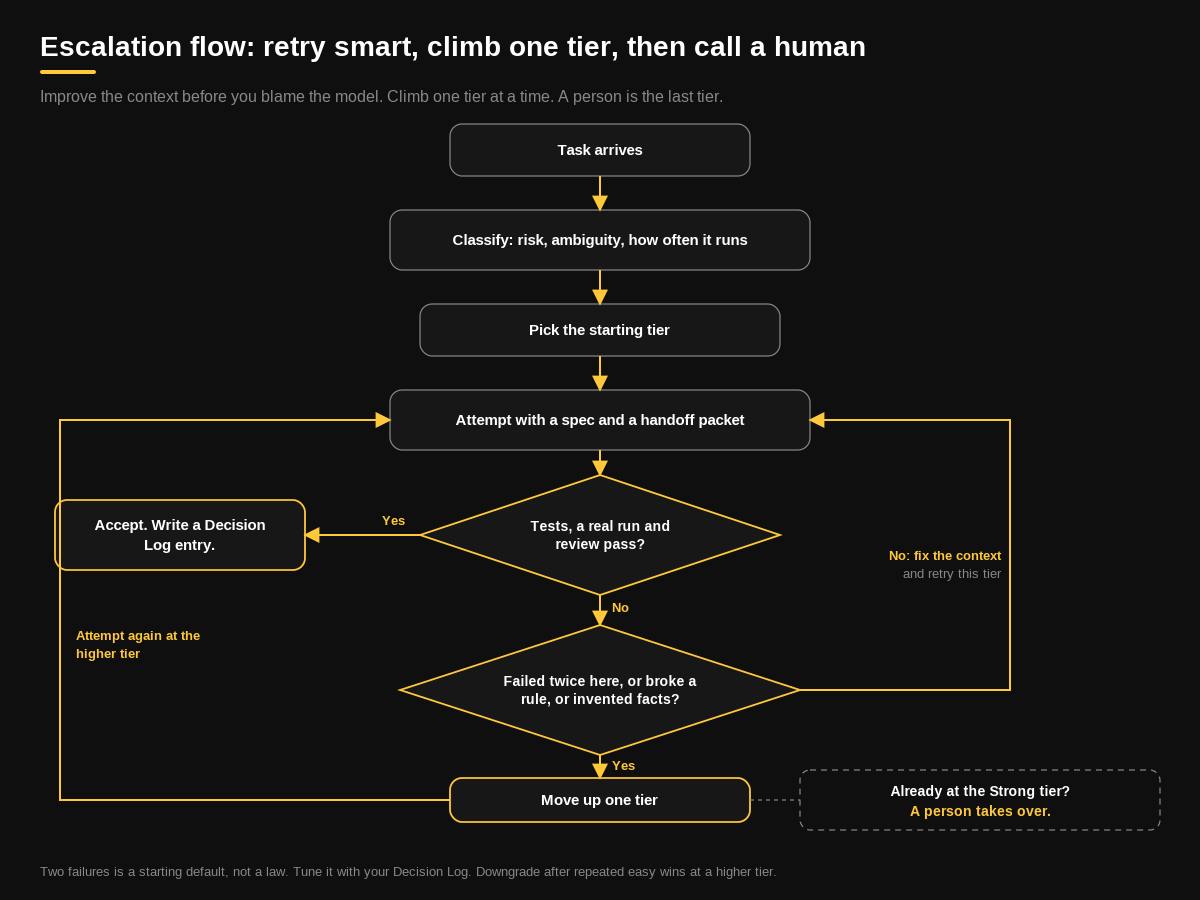
Here is my baseline operational escalation protocol:
- The Two-Strike Boundary: If a model at a given tier fails twice consecutively, stop tweaking prompt prose. Prune context noise first, then escalate one tier up.
- Hallucination Triggers Immediate Escalation: If a model invents phantom APIs, non-existent workspace packages, or fake configuration flags, bypass the two-strike counter and escalate immediately. Hallucination signals model saturation on that problem complexity.
- De-escalation Feedback: Conversely, if the Strong Tier completes a class of tasks three times without human correction, test routing subsequent runs through the Balanced Tier.
- Human Escalation: If the Strong Tier fails to resolve the problem after two iterations, human intervention is mandatory. At that junction, the root cause is rarely model capability; it is almost always underspecified requirements or conflicting architectural constraints.
'Two Strikes' Is a Practical Heuristic
The threshold of two attempts is an engineering heuristic, not a mathematical law. Audit your Decision Log (Step 11) to measure at what failure count tier escalation became net-positive for your workflow, and adjust the threshold accordingly.
Action for Step 7: Review routing-kit/03-escalation-rules.md in the repository, select five escalation triggers tailored to your stack, and paste them into your project's AGENTS.md.
Step 8: Context Hygiene and Handoff Packets
Vast context windows create a dangerous illusion: developers assume they can dump an entire monolithic repository into the prompt and expect perfection. But holding 1 million tokens in working memory is vastly different from reasoning reliably over that volume. In Chroma's 2025 Context Rot Report (opens in a new tab), testing across 18 models demonstrated that as context length expands, retrieval degradation and reasoning inconsistencies mount, even on straightforward tasks. While newer model iterations continuously improve needle-in-a-haystack retrieval, the operational best practice remains timeless: provide dense, relevant context; and when a conversation history bloats, compact state into a concise summary and start a fresh session.
This principle brings us to project-level instruction files. Codex and broader ecosystem tools parse AGENTS.md (the established 'README for AI agents'). Claude Code parses CLAUDE.md, while Gemini CLI and Antigravity default to GEMINI.md. Attempting to maintain duplicate engineering guidelines across three distinct files guarantees divergence: the one file you forget to update is invariably the one your agent reads. The clean pattern is maintaining a single source of truth in AGENTS.md, importing it into peripheral config files via import directives: @AGENTS.md inside CLAUDE.md and @./AGENTS.md inside GEMINI.md, as detailed in CrewAI's tooling documentation (opens in a new tab).
Ecosystem Divergence Around Direct AGENTS.md Support
Conflicting documentation exists regarding whether modern versions of Claude Code natively ingest AGENTS.md directly or require an explicit CLAUDE.md. Using explicit import lines works reliably in both environments, making it the safest cross-harness approach.
Watch instruction file size limits. Codex's sample configuration indicates a default project_doc_max_bytes ceiling of 32,768 bytes, meaning only the first 32 KB of your instruction file loads into the initial agent turn. Keep instructions compact and testable: replace vague directives like 'keep code clean' with 'use 2-space indentation'; replace 'test thoroughly' with 'run npm test before committing'. Rules that cannot be verified by a deterministic script confuse human engineers and language models alike.
When handing off tasks between different agent sessions or model tiers, assemble a structured Handoff Packet so the incoming model does not guess from scratch. The packet should define: overall goal, architectural decisions made and rationale, non-negotiable constraints, active branch status, modified files, tests executed with stdout, open edge cases, and immediate next steps. A production template is available in routing-kit/07-handoff-packet.md.
Step 9: Cost per Accepted Output
Selecting a model based solely on raw input/output token pricing is like buying equipment based only on purchase price without factoring in failure rates. A far more actionable engineering metric is Cost per Accepted Output. The formula incorporates human engineering overhead alongside token spend:
Every rejected model attempt still consumed expensive engineering time for review and triage.
Let us evaluate an explicit illustrative scenario (all numbers represent hypothetical modeling). Assume each attempt consumes 80,000 input tokens and 15,000 output tokens (including thinking tokens), omitting prompt caching. Human review overhead is pegged conservatively at $10 per review cycle. On complex tasks, assume baseline success rates of 30% for the Fast Tier, 60% for the Balanced Tier, and 80% for the Strong Tier. On routine tasks, assume success rates of 90%, 95%, and 95% respectively.
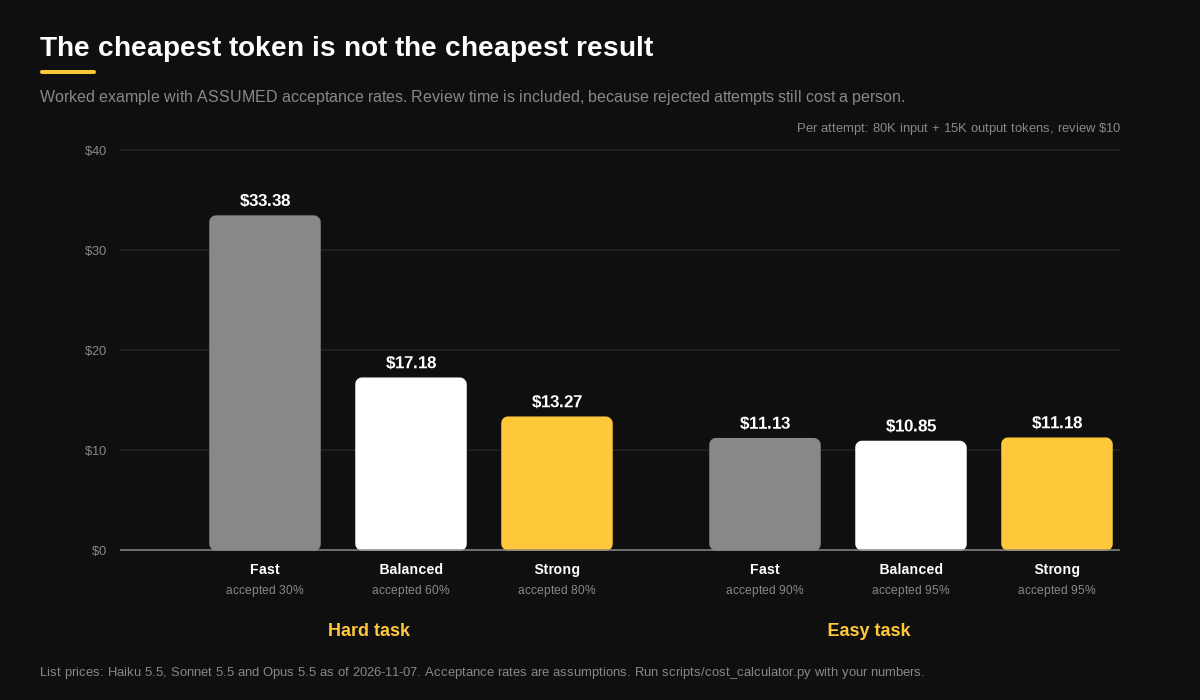
The outcome is revealing. Raw API spend per attempt on the complex task runs approximately $1.0155 on Fast, $1.31 on Balanced, and $1.62 on Strong. But once human review overhead is calculated, the true Cost per Accepted Output on complex tasks becomes $13.38 on Fast, $17.18 on Balanced, and $13.27 on Strong. The tier with the lowest token rates ended up producing the most expensive deliverable, because repeated human review loops dwarfed raw model API spend. Conversely, on routine tasks, all three tiers converge to roughly equivalent net costs ($11.13, $10.85, $11.18), making the Fast Tier the superior engineering choice due to faster turnaround times.
This architectural principle does not hinge on exact dollars; it hinges on economic structure: the higher the cost of engineering review, the greater the penalty for deploying economy models on high-complexity problems. You can run your own organizational metrics using scripts/cost_calculator.py in the companion repository (python3 scripts/cost_calculator.py --demo runs the benchmark scenario above). Note that prompt caching shifts these economics: industry guides note that cached inputs for GPT-6 Sol cost a fraction of base rates, though cache eviction policies differ across vendors.
Potential Tier Step-Ups on Large Context Windows
Third-party pricing analyses (opens in a new tab) note that Haiku 5.5 requests exceeding 100,000 tokens may trigger higher pricing multipliers. Check your provider's official documentation if your pipelines routinely dispatch prompts exceeding 100K tokens.
Step 10: Verification, From "Looks Right" to "Actually Runs"
Recall the Kubernetes deployment incident mentioned earlier: every generated manifest passed yaml linting, but none ran on a cluster because the nginx image expected root privileges to initialize cache directories. That incident underscores the core tenet of verification: any evaluation step that can be bypassed by plausible-looking text (such as static linting, loose type-checking, or the model's self-affirmation that 'everything looks good') is insufficient. Reliable verification requires runtime evidence generated outside the model's token stream: real test runners, real execution environments, real stdout.
Every task specification must define an explicit 'Definition of Done' incorporating three non-negotiable criteria:
- Automated tests passed, with exact CLI stdout logs captured.
- The code ran in a physical runtime environment (dev server booted, migration completed, HTTP endpoint responded with 200).
- The diff was inspected by a human engineer or an independent reviewer model that did not author the implementation.
If any of these three pillars is missing, the task is merely 'almost done,' not 'done.'
Demand Concrete Execution Proof
Include this directive in your operational prompts: 'Before marking this task complete, output the exact shell command executed and paste its raw stdout.' While this eases auditing, it does not replace independent engineer verification: always run the verification command yourself.
Action for Step 10: Check routing-kit/10-verification-gates.md in the repository for validation criteria spanning linting to human gates, and deploy templates/docs/pull-request-ai-template.md to .github/PULL_REQUEST_TEMPLATE.md to enforce verification logs across all pull requests.
Step 11: An End-to-End Walkthrough
Let us connect these principles through a cohesive lifecycle scenario. Again, this represents an illustrative case study to demonstrate how these mechanics operate across feature development. The scenario is universally familiar: implementing a Team Invitation system in a B2B SaaS platform.
Brainstorming and PRD: The team engaged the Strong Tier to surface edge cases: invite link expiration windows, duplicate invites sent to existing registered users, and idempotent resend mechanics. For the PRD, the team initially attempted to save time using the Fast Tier, producing vague acceptance criteria ('invitations should work smoothly'). At the Scope Gate, an engineer flagged the ambiguity, routing the step to the Balanced Tier with an explicit directive: 'Interview me with clarifying questions before generating the spec.' The cost of this correction was negligible, but without that Human Gate, vague specifications would have contaminated downstream implementation.
Architecture Phase: The central decision was token hashing and storage architecture. Notice in the interface mockup below how the prompt is structured into Phase, Goal, Context, Constraints, Deliverables, and Done Criteria (provided in routing-kit/04-phase-prompt-templates.md). The side panel illustrates the active tier, fallback model, escalation boundaries, and human signoff gates.
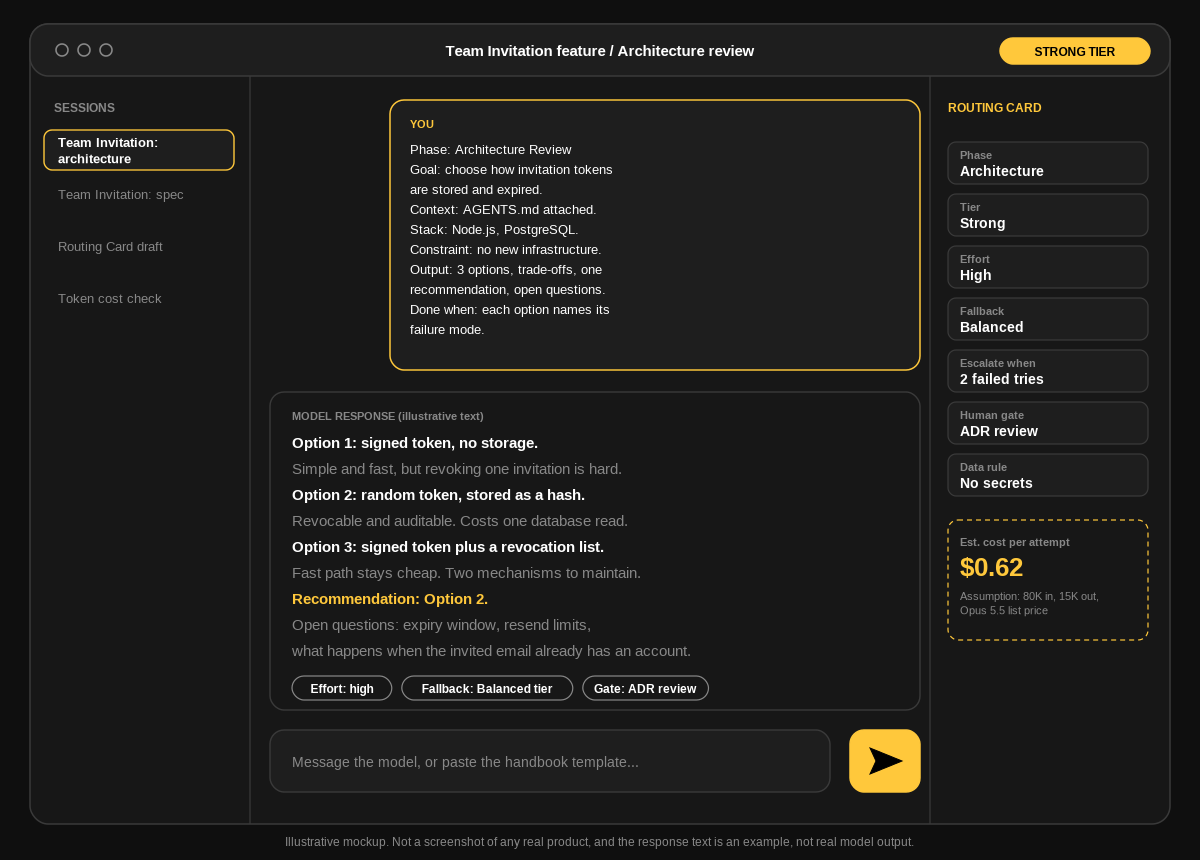
Illustrative Interface Wireframe
The mockup illustrates architectural information flow. The response text represents a synthetic walkthrough example, not raw model output. Replace it with your actual workspace harness captures during team reviews.
Implementation and Review: The Balanced Tier generated the schema migrations, mailer services, and token endpoints. An initial review performed by the same model family missed a subtle timezone conversion bug on token expiry timestamps. When the diff was evaluated by an independent review model, the edge case was caught and resolved immediately. (This illustrates the practical benefit of addressing self-preference bias discussed in Step 6). During debugging of a broken token test, the team initially jumped straight to the Strong Tier without reviewing logs; the retrospective codified a rule requiring Fast Tier log triage before pulling in heavy reasoning.
At the end of each milestone, log a brief Decision Log entry: chosen model, rationale, outcome, and post-mortem notes. This practice grounds your routing cards in empirical engineering reality over time. See routing-kit/05-decision-log.md for a clean starter format.
Step 12: A 30-Minute Routine for Evaluating New Models
Because language models evolve rapidly, your routing system must incorporate an efficient intake routine rather than requiring panic-driven rearchitecting every time a vendor ships an update. I use a disciplined 30-minute evaluation protocol:
- Minute 0 to 5: Document the official model identifier, token pricing tiers, context ceiling, and reasoning effort controls directly from the vendor's documentation (avoiding secondhand summaries).
- Minute 5 to 20: Execute the three standardized benchmark tasks defined in Step 2 against the candidate model, recording speed, accuracy, and instruction fidelity.
- Minute 20 to 30: Compare outcomes against your active tier champions and update the corresponding rows in your Routing Card. Log a dated one-line entry in your project changelog.
Two operational precautions apply here:
- Re-verify existing prompt templates and
AGENTS.mdrules whenever onboarding a new model family, as instruction sensitivity varies across architectures. - Anchor model strings in centralized environment variables or configuration files so updates require a single-line diff. As noted in Claude Code's documentation, generic aliases migrate to newer snapshots over time; pin explicit model versions when reproducibility is mandatory.
A checklist for this protocol is available in routing-kit/09-new-model-checklist.md.
Recap and Production Checklist
To distill the entire system into a cohesive mental model: Harness and Model are separate decisions. Evaluate models across five axes, never by public leaderboards alone. Audit your Token Tax when working across multiple languages. Assign abstracted tiers across project lifecycle phases, protected by three mandatory Human Gates. Use the Decision Matrix for rapid ad-hoc routing. Separate Planner, Executor, and Reviewer on high-blast-radius tasks. Establish proactive escalation rules before loops fail. Keep context compact and maintain AGENTS.md as your single source of truth. Model cost as Cost per Accepted Output. And never declare a task complete without runtime verification and independent review.
Here is your production readiness audit:
Before Every Task
- What is the blast radius and reversibility, and how clear is the written spec?
- What model tier and reasoning effort does your Routing Card prescribe for this phase?
- Are the Handoff Packet and
AGENTS.mdcurrent? - Does the Definition of Done require runtime test execution and independent review?
- What are the exact escalation triggers and where does the next human signoff gate sit?
At Project Setup (Once)
- Author
AGENTS.mdand import it intoCLAUDE.mdandGEMINI.md. - Calibrate your team Routing Card against three representative internal benchmark tasks.
- Establish strict data governance rules: which codebase assets or schemas are prohibited from third-party model ingestion.
- Initialize the team Decision Log and calibrate the cost calculator with your operational numbers.
Monthly Maintenance
- Run the 30-minute intake routine when new model iterations drop.
- Review the Decision Log to calibrate escalation thresholds and tier assignments.
- Audit vendor pricing tables for rate changes or promotional expiration windows.
Sources and Limitations
Claude pricing and context window metrics cite Anthropic's Model Documentation (opens in a new tab). Claude Code aliases, opusplan, and reasoning effort controls cite the Model Configuration (opens in a new tab) guide, with /advisor details from the Advisor Documentation (opens in a new tab). Codex profiles and reasoning configuration cite OpenAI's Codex Documentation (opens in a new tab). GPT-6 family release dates and pricing cite independent comparative studies (opens in a new tab) referencing upstream OpenAI pricing tables. Gemini 4 Argon pricing, reasoning effort levels, and benchmarks cite an independent technical analysis (opens in a new tab). Academic literature: Panickssery et al., NeurIPS 2024 (opens in a new tab), Petrov et al., NeurIPS 2023 (opens in a new tab), and Chroma, Context Rot, 2025 (opens in a new tab). Every cited claim and verification source is indexed in the repository's SOURCES.md.
Limitations are stated transparently: I have not executed independent scientific benchmarks across Codex or Antigravity, so I make no comparative performance claims under my own name. Numerical models in Step 9 are hypothetical scenarios illustrating economic structure. Step 11 represents a synthetic walkthrough. The cited research papers evaluated earlier model generations; contemporary models may exhibit different properties. Model flags, pricing structures, and vendor features evolve quickly: always cross-reference official provider documentation. If you spot a discrepancy in this handbook, please submit an issue on the repository (opens in a new tab) and I will add an errata note to the changelog.